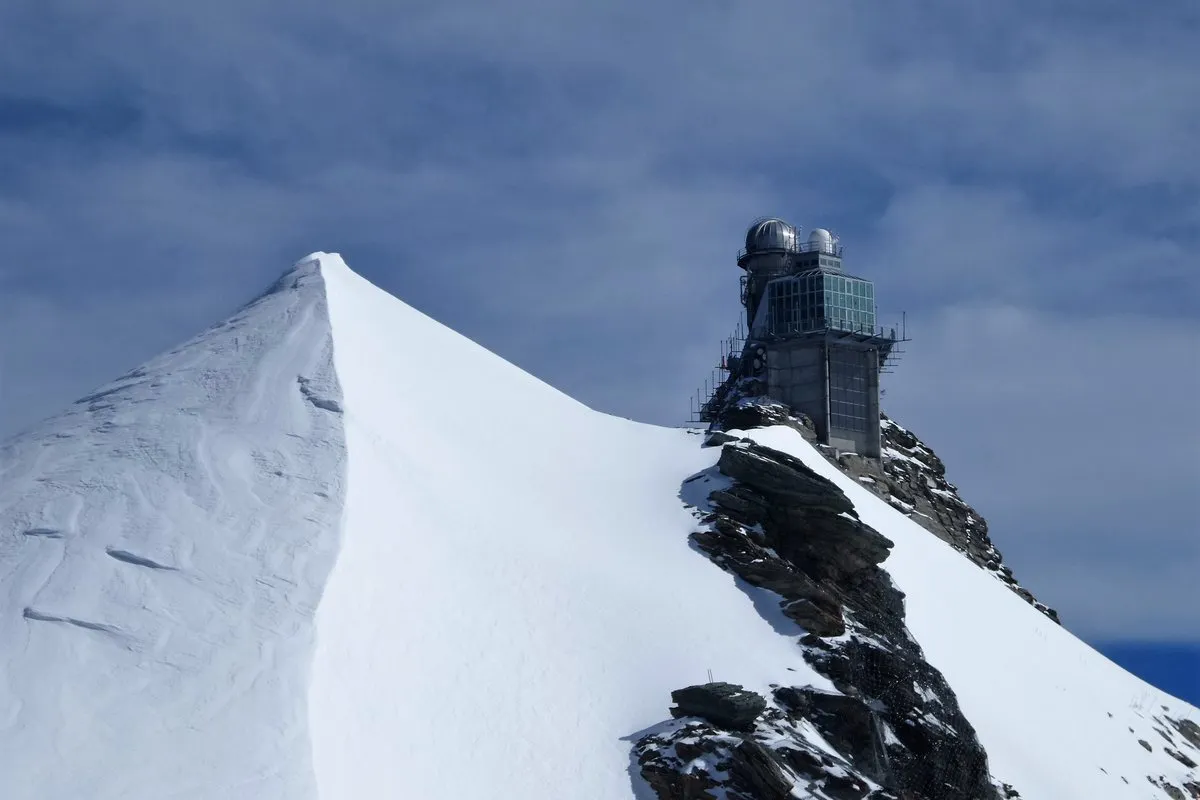
A railway begun in 1896 still tunnels through the Eiger and the Mönch to a glacier saddle at 3,454 metres. At the top: the Sphinx Observatory, an ice palace carved by hand in the 1930s and the head of the Aletsch, the longest glacier in the Alps.
In this story · 3 sections
The Jungfraujoch is a glacier saddle at 3,463 metres between two great four-thousanders of the Bernese Alps, the Jungfrau and the Mönch, on the border between the cantons of Bern and Valais. Its north side falls almost vertically towards Interlaken; its south side is the gentle Jungfraufirn, one of the sources of the Aletsch glacier, the largest and longest in the Alps. The only quick way up is by train – and that train runs through the mountains rather than up them. For more Alpine journeys, see our Alps guides.
2 places
Sixteen years inside the Eiger
In 1894 the industrialist Adolf Guyer-Zeller received a concession for a rack railway from Kleine Scheidegg, with a long tunnel through the Eiger and Mönch to the very summit of the Jungfrau. Work began in 1896. The line reached Eigergletscher in 1898; the following year six workers died in an explosion, the crews struck for four months and Guyer-Zeller himself died. The tunnel crept upwards – Eigerwand station in 1903, Eismeer in 1905 – until, on 21 February 1912, the miners broke through the glacier at the Jungfraujoch. The summit plan was abandoned, and the railway opened to the saddle on 1 August 1912.
The journey
Start in Interlaken and take the Berner Oberland-Bahn to Lauterbrunnen or Grindelwald, then the Wengernalpbahn to Kleine Scheidegg at 2,061 metres, the railway pass between the two valleys. There the Jungfrau Railway begins: 9.34 kilometres, of which the last 7.32 run underground. The train stops at Eismeer, at 3,158 metres; the Eigerwand stop closed in December 2016. About a million people make the trip each year.
At the top
The underground terminus, at 3,454 metres, is the highest railway station in Europe. It connects to the Top of Europe building by Ernst E. Anderegg, opened in 1987 after fire destroyed the old Berghaus in 1972, with restaurants, shops, exhibitions and a post office. From the station, Switzerland's fastest lift rises 108 metres in 25 seconds to the Sphinx, where the observatory and its public terrace stand at 3,571 metres, among the highest in the world. Its 76-centimetre telescope and laboratories still serve long-term research, and in 1949 plates exposed to cosmic rays here gave the first precise evidence of the charged K-meson.
Back in the glacier, the Ice Palace is a labyrinth of about 1,000 square metres that two mountain guides began cutting by hand, with ice axes and saws, in 1934. It was never finished. Because of the warmth of its many visitors it has to be cooled to minus three degrees, and its vaults are recut regularly. Tunnels also lead out onto the snow, where secured trails cross the crevassed glacier to the Mönchsjoch Hut.
Dress for winter whatever the month, and allow time to adjust to the altitude. For more travel reading, browse Metro Mode Travel and our destination guides; across the French border, VERA PI tracks Chamonix property prices below Mont Blanc.
Sphinx Observatory
Terrace at 3,571 m
Reached by lift from the Jungfraujoch station; views of the Jungfrau, Mönch and Eiger.
Kleine Scheidegg
Where the Jungfrau Railway begins
The railway pass between Lauterbrunnen and Grindelwald, at 2,061 metres.