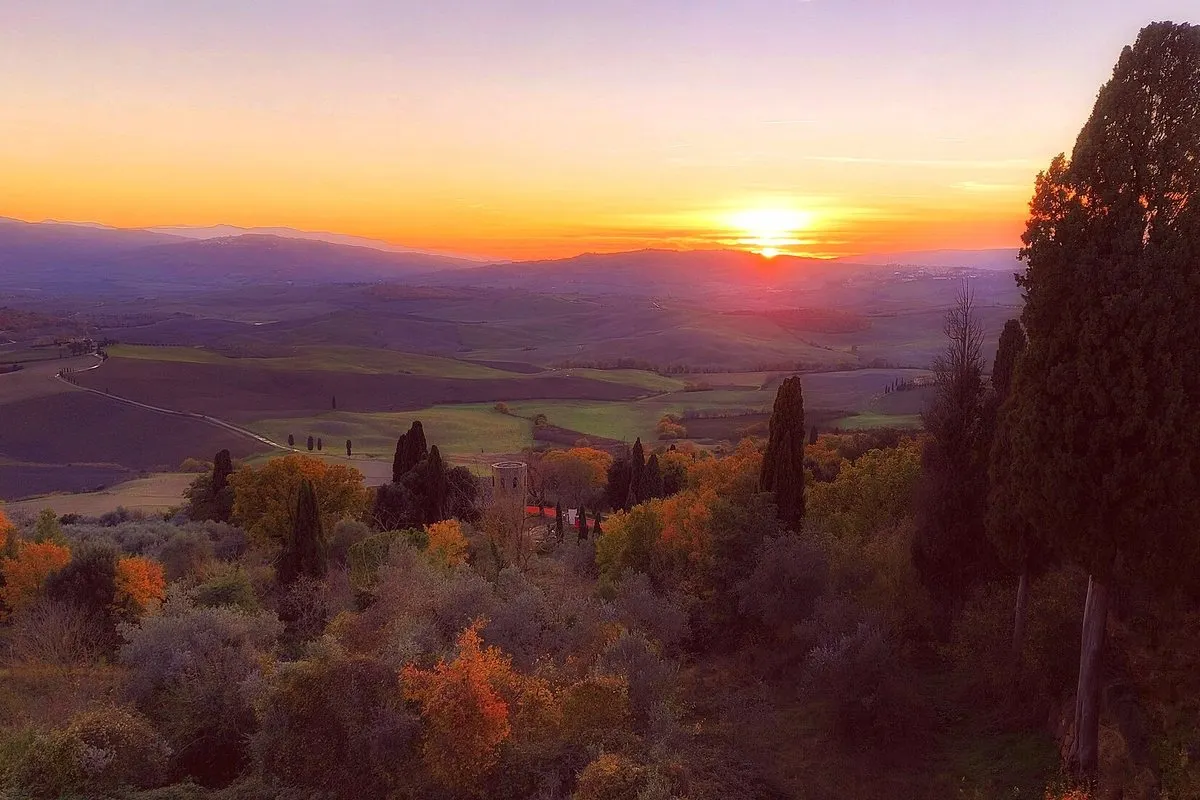
The Tuscan countryside has been shaped by estates owned by the same families for centuries – and by a few that were founded to challenge them. Five addresses tell the story, from the Ricasoli castle in Chianti to the Sassicaia stone fields on the coast.
In this story · 7 sections
Tuscany is no uniform countryside. In the north lies Chianti, the hills between Florence and Siena. South of Siena, Val d'Orcia stretches out towards Mount Amiata. And on the coast to the west, in Maremma, lies Bolgheri, where one of Italy's most talked-about wines was born after the war. What all three have in common is that the landscape has been shaped by large estates, owned by the same families for generations.
Here are five addresses that together tell that story, from medieval castles to wine estates founded fifty years ago. All of them require a car, and all are worth the detour it involves.
5 places
© OpenStreetMap contributors · OpenFreeMap
Castello di Brolio: the Ricasoli family's castle in Chianti
In Gaiole in Chianti, around twenty kilometres north-east of Siena, lies Castello di Brolio, a castle, a palace and a garden on a pentagonal base. The Ricasoli family has owned it for centuries. The castle was destroyed several times in the wars between Siena and Florence and was rebuilt around the year 1500 after the Sienese army had demolished it. The large brick palace in neo-Gothic style was built mainly under Baron Bettino Ricasoli, who was also prime minister of the Kingdom of Italy.
Ricasoli is the man behind modern Chianti wine. The exact grape formula often attributed to him is disputed, but it was his decision to make sangiovese the main grape that had lasting significance for Tuscan and Italian wine. The family company Ricasoli 1141 still makes wine at Brolio, and the estate welcomes visitors on guided tours.
Val d'Orcia: the landscape that became a World Heritage Site
South of Siena begins the Val d'Orcia, a cultivated hill landscape that stretches towards Monte Amiata, between the provinces of Siena and Grosseto. It has been depicted from Renaissance painting to modern photography, and in 2004 the entire valley was placed on UNESCO's World Heritage List as a cultural landscape. Ridley Scott's Gladiator was partly filmed here. A railway from the 19th century runs through the valley between Asciano and Monte Antico. Regular services were discontinued in 1994, but the tracks, stations and tunnels are kept in operation for historic trains.
Pienza: the pope's ideal town
In the middle of the valley, between Montepulciano and Montalcino, lies Pienza. The village was called Corsignano when Enea Silvio Piccolomini was born here in 1405. When he became Pope Pius II, he had the entire village rebuilt into an ideal Renaissance town and named it after himself. The architect was the Florentine Bernardo Rossellino, possibly in collaboration with Leon Battista Alberti, and construction began around 1459. Pienza is called the touchstone of Renaissance town planning and became a World Heritage Site in 1996.
The trapezoidal square Piazza Pio II is framed by four buildings: Palazzo Piccolomini, the pope's residence, to the west, the cathedral with one of the earliest Renaissance façades in the middle, Palazzo Vescovile, which was built by Cardinal Rodrigo Borgia – later Pope Alexander VI – and the town hall with its loggia of three arches.
Castiglion del Bosco: an estate in Montalcino
West of Pienza lies Montalcino, around eighty kilometres south of Florence and home to Brunello di Montalcino, one of Italy's most renowned wines. It is made from 100 per cent sangiovese. In the mid-1800s, Clemente Santi began making an age-worthy wine from sangiovese alone, and his grandson Ferruccio Biondi-Santi released the first modern brunello in 1888. In 1980, Brunello di Montalcino was one of the first four wines in Italy to receive DOCG status.
Castiglion del Bosco is one of the estates behind it. It covers 2,000 hectares, mostly dense forest and hunting grounds, of which 62 hectares are sangiovese, and it was one of the founders of the Brunello consortium in 1967. On the estate are the ruins of a 12th-century castle, and in the small church of San Michele hangs Pietro Lorenzetti's fresco Annunciazione from 1345. From 1318 the estate was owned by the merchant family Gallerani from Siena. Massimo and Chiara Ferragamo bought it in 2003 and restored it, and in March 2022 it was transferred to an international family office.
Bolgheri: Sassicaia and Ornellaia
Furthest to the west, near the coast in the province of Livorno, lies Bolgheri, a small village around a red-brick castle built by the Della Gherardesca counts. The poet Giosuè Carducci spent part of his childhood here. It is here that the Super Tuscans were born.
Marquis Mario Incisa della Rocchetta planted cabernet sauvignon at Tenuta San Guido and made his first wine in 1948. The name Sassicaia comes from sasso, stone, after the stony ground. For years the wine was drunk only by the family, until his son Nicolò and his nephew Piero Antinori persuaded him to release the 1968 vintage, which was presented in 1971. At a tasting held by Decanter in 1978, Sassicaia 1972 won ahead of 33 wines from eleven countries. Since 1994 the wine has had its own appellation, Bolgheri Sassicaia DOC, the only wine from a single estate in Italy with a DOC of its own.
Neighbouring San Guido is Ornellaia, founded by Marquis Lodovico Antinori, Nicolò Incisa's cousin, with winemaker Tibor Gál. The vines were planted in 1981 and the first vintage came in 1985. Since 2005, the estate has been wholly owned by the Frescobaldi family, and alongside Ornellaia it makes Masseto, a wine based on merlot.
At a glance
Estates at a glance
| Place | Area | Known for |
|---|---|---|
| Castello di Brolio | Chianti | The Ricasoli family's castle for centuries |
| Pienza | Val d'Orcia | Pius II's ideal town, UNESCO World Heritage Site in 1996 |
| Castiglion del Bosco | Montalcino | 2,000 hectares, Brunello, Lorenzetti's fresco |
| Tenuta San Guido | Bolgheri | Sassicaia, first wine 1948 |
| Ornellaia | Bolgheri | Ornellaia and Masseto, first vintage 1985 |
More to read
Continue the journey in Florence with our walk Florence on the Medici path, or head north to the lakes with 48 hours in Bellagio. All our city guides and destinations can be found at metromode.co.
Places
Castello di Brolio
The Ricasoli family's castle and palace for centuries, with guided tours.
Insider tipAbout 20 km north-east of Siena
Montalcino
The home town of Brunello di Montalcino, about eighty kilometres south of Florence.
Castiglion del Bosco
An estate of 2,000 hectares with a 12th-century castle ruin and Lorenzetti's fresco from 1345.
Bolgheri
The village around the Della Gherardesca castle, neighbouring Tenuta San Guido and Ornellaia.