In this story · 5 sections
Vallauris is a hill town that runs down to the sea at Golfe-Juan, bordering Antibes to the west. Its name comes from Vallis Aurea, the golden valley, recorded in the tenth century, and for most of its history it lived from the earth: cooking pots, then art pottery. Then, in 1948, Pablo Picasso moved in.
He stayed until 1955, made Vallauris a household name in the art world and was made a freeman of the town. Seventy years on, the potters are fewer, but the château, the square and the old lanes still tell the story.
4 places
© OpenStreetMap contributors · OpenFreeMap
- 01Château de Vallaurissee · Vieille ville
- 02L'Homme au moutonsee · Vieille ville
- 03Chapelle de la Miséricordesee · Vieille ville
- 04Vieux port de Golfe-Juansee · Golfe-Juan
- 1948
- Moves to Vallauris and takes up ceramics
- 1950
- Gives the town L'Homme au mouton
- 1953
- Paints the Coupelles tauromachiques series in his studio, 12–17 April
- 1955
- Donates War and Peace; leaves Vallauris
- 1961
- Marries Jacqueline Roque at the town hall
A village rebuilt by the monks of Lérins
Vallauris belonged for centuries to the monastery on the Îles de Lérins. On 20 April 1501 Dom Raynier Lascaris, prior of Lérins and lord of Vallauris, granted the whole territory in perpetual lease to families from his county of Ventimiglia, and imposed a plan for rebuilding the village. That grid of streets is the origin of the old town. In 1540 there were 98 houses; by 1765 there were 293, with 1,309 inhabitants.
Pottery was always the backbone of the economy. In the early 20th century the Massier family turned kitchenware into art ceramics, and Vallauris began to call itself the French city of ceramics, a claim its international biennale keeps alive.
Picasso's Vallauris, 1948–1955
After the Second World War the town drew artists including Roger Capron, André Baud, Robert Picault and Gilbert Valentin. Picasso arrived in 1948 and threw himself into ceramics and linocuts. His ceramic work was published exclusively by the Madoura workshop of Suzanne Ramié, and his years here are remembered as a golden age when, as locals say, everyone was a potter.
His household lived here too: Françoise Gilot with their children Claude and Paloma, and later Jacqueline Roque, whom he married in great secrecy at Vallauris town hall in 1961. His son Paulo married Émilienne Lotte here in 1950. Even the town barber, Eugenio Arias, a former Spanish Republican soldier, became part of the legend as "Picasso's barber".
Picasso gave the town two great gifts. In 1950 came L'Homme au mouton, the bronze shepherd carrying a lamb, which stands on the Place Paul-Isnard. In 1955 he gave War and Peace, the mural that fills the vaulted chapel of the château, now the Musée national Picasso.
The château: three museums in one
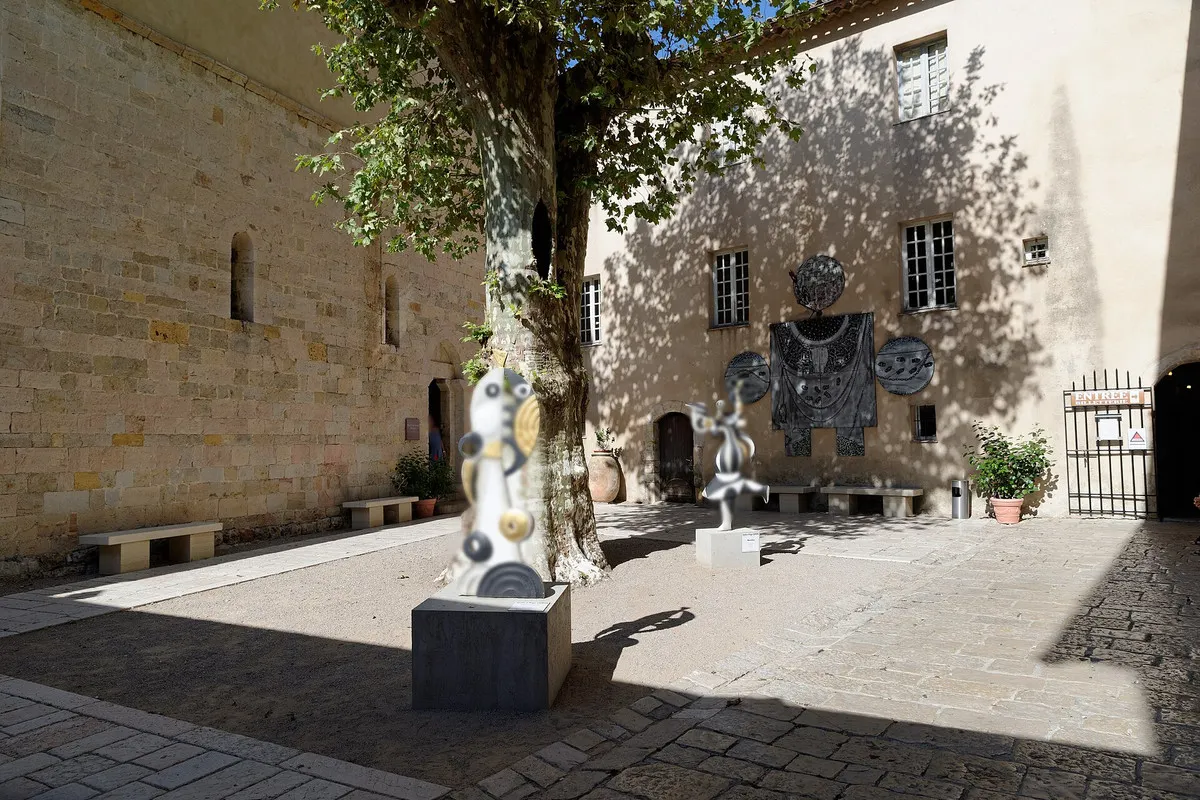
The Château de Vallauris, on the Place de la Libération, brings everything together. Alongside the Musée national Picasso and War and Peace, it houses the Musée Magnelli – musée de la céramique, one of the few places in France devoted to contemporary ceramic art. The sunlit courtyard is a good place to pause between them.
The potters today
The honest picture is a mixed one. Around 250 workshops operated in the 1960s; only a handful remain, and many ceramic shops have given way to banks and estate agents. Since 2015 part of the old centre has been given protected status. Seek out the remaining studios on and around the main street, and you are buying into a tradition that Picasso himself helped to save.
Golfe-Juan and Napoleon
Down on the coast, Golfe-Juan is the commune's seaside half. It grew with tourism and the railway in the second half of the 19th century, when villas climbed the hillsides. Its great historical moment came on 1 March 1815, when Napoleon landed here from Elba with 900 grenadiers; by 20 March he was back at the Tuileries. Nearby, the Château de l'Horizon was once owned by Prince Aly Khan.
Château de Vallauris
Musée national Picasso and Musée Magnelli
Picasso's War and Peace in the vaulted chapel, plus contemporary ceramics.
Place de la Libération, 06220 Vallauris
Insider tipCheck opening days before you travel.
L'Homme au mouton
Picasso's bronze shepherd, given in 1950
The bronze man carrying a lamb, a few steps from the château.
Place Paul-Isnard, 06220 Vallauris
Insider tipCombine with the château museums.
Chapelle de la Miséricorde
The former Black Penitents' chapel of 1664
A 17th-century chapel in the old town.
Place Jules-Lisnard, 06220 Vallauris
Insider tipA short walk from the main square.
Vieux port de Golfe-Juan
The harbour where Napoleon came ashore
The seaside half of the commune, where Napoleon landed on 1 March 1815.
Vieux port, 06220 Golfe-Juan
Insider tipGolfe-Juan-Vallauris station is close by.
Neighbourhood and property data for Vallauris and neighbouring Cannes is on VERA PI, and more Riviera stories are on metromode.co.