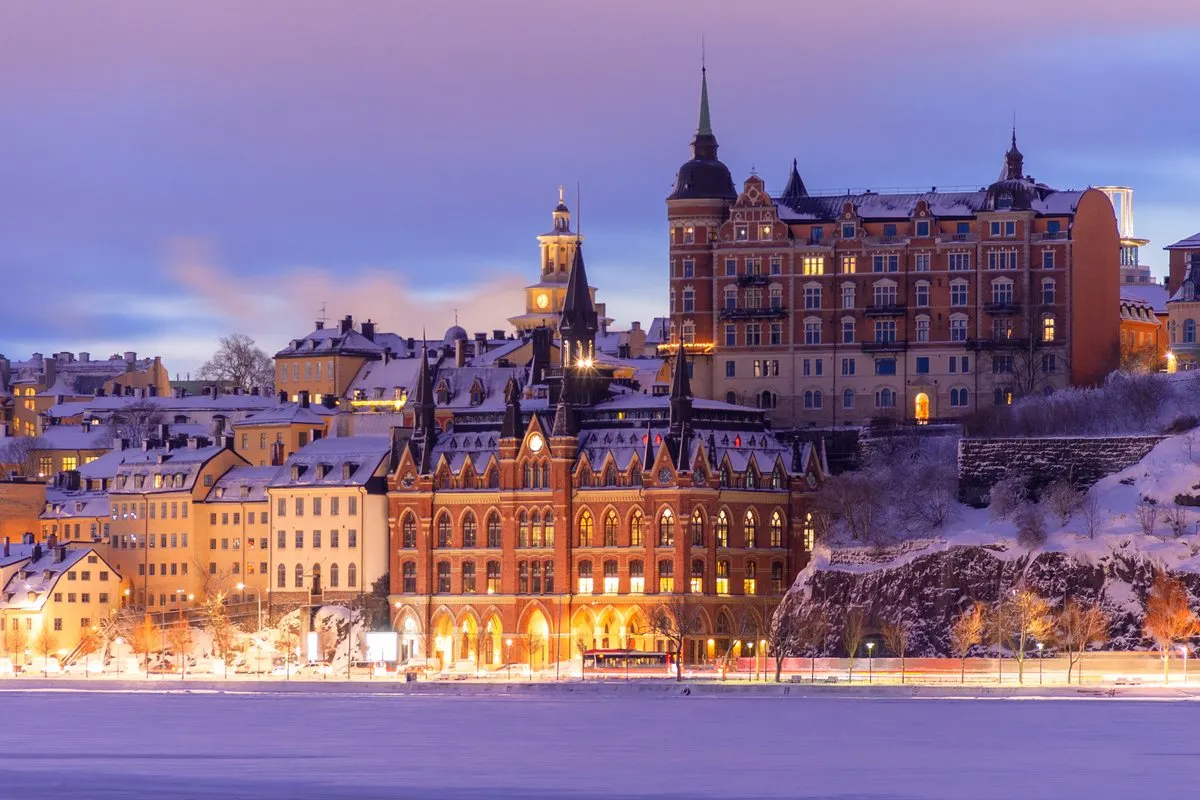
At the winter solstice, Stockholm has just over six hours of daylight. But after Christmas, it turns, and January and February offer the lowest, most beautiful light, frozen lakes and warm bathhouses. Here's the guide to Stockholm's other winter.
In this story · 5 sections
Stockholm in winter has a reputation for darkness, and in December it's well-earned. At the winter solstice in 2019, the sun rose at 8.44am and set at 2.49pm – just over six hours of daylight, according to The Local. But those who arrive after Christmas meet a different city. The light returns with each passing day, the sun hangs low and golden over the ice, and the city that lived by the glow of fairy lights in December begins to move outdoors again.
2 places
© OpenStreetMap contributors · OpenFreeMap
Daylight in Stockholm- Winter solstice 2019
- Sunrise 8.44am, sunset 2.49pm
- New Year
- Around five minutes more daylight than at the solstice
- Second half of January
- About four minutes longer per day
- Midsummer's Eve 2019
- Sunrise 3.32am, sunset 10.06pm
The light that grows – four minutes a day
Around New Year, Stockholm and southern Sweden have about five minutes more daylight than at the solstice, and during the second half of January the days get longer by an average of four minutes per day. The low sunlight, which never climbs high above the horizon, casts a warm glow over the façades on Strandvägen and Riddarholmen already in the middle of the day. As a contrast: on Midsummer's Eve the same year, the sun rose at 3.32am and set at 10.06pm.
Lucia – the light in the midst of darkness
Winter in Stockholm really begins with light. The Lucia celebration, with processions dressed in white and live candles in their hair, was taken up seriously as a tradition worth preserving at Bollnässtugan at Skansen in 1893, according to Wikipedia. Skansen, the open-air museum on Djurgården founded in 1891, still marks Lucia, and during Advent Skansen's Christmas market is held. Once Christmas is over, the city takes on its true winter spirit.
Ice – Vikingarännet and Nordic long-distance skating
When the cold sets in, ice forms on Lake Mälaren and in the archipelago, and Stockholmers bring out their long-distance skates. The most famous tour is Vikingarännet, a race of up to 80 kilometres between Uppsala and Stockholm along an old Viking route on Lake Mälaren. It has been organised since 1999, and the length of the course is determined each year by the ice and snow; in 2011, over 2,500 skaters took part, according to Sveriges Radio.
Natural ice is never guaranteed, and it is never safe. Never go out on the ice alone or without rescue equipment, and follow local skating clubs' advice on where the ice is safe to skate. Those who want safety first can book a guided tour.
Warmth – Centralbadet from 1904
After the ice comes the warmth. Centralbadet at Drottninggatan 88 was built in 1904 by the architect and entrepreneur Wilhelm Klemming, with an Art Nouveau exterior and interior that have been preserved through the renovations. You enter through a winding garden in the courtyard, and the large pool is called the bathhouse's jewel. An afternoon at the baths, with darkness falling outside, is one of the most quintessentially Stockholm winter experiences.
A winter's day in Stockholm
Start with a walk in the low morning light along Strandvägen and out to Djurgården. Have lunch early, while it is still light, and spend the afternoon at Centralbadet or at a museum. If you want the Christmas and Advent city, you'll find it in Stockholm in winter in My Stockholm. Also see VERA PI's street files for Drottninggatan and Strandvägen, and Djurgården.
Centralbadet
Art Nouveau baths from 1904
Wilhelm Klemming's bathhouse with garden and large pool.
Drottninggatan 88, Stockholm
Skansen
Lucia and Christmas market
Where the Lucia celebration was taken up in 1893.
Djurgården, Stockholm