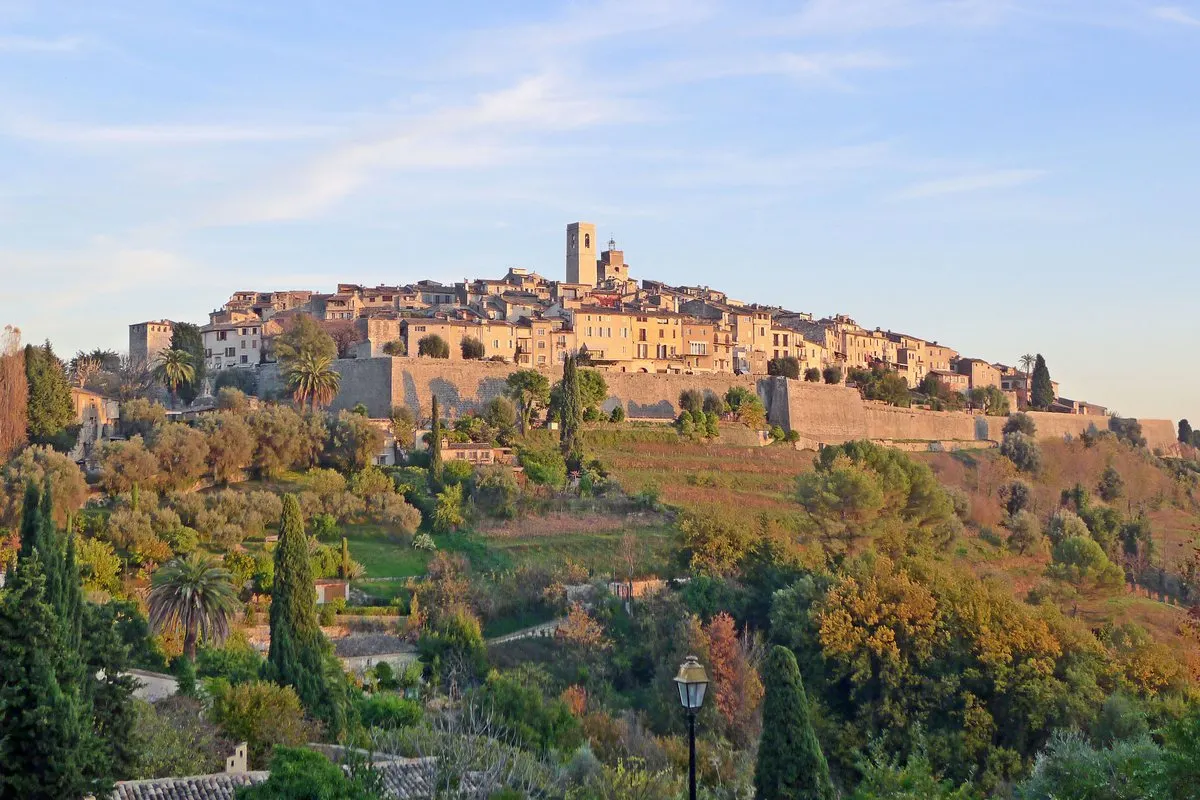
A fortified medieval village, one of Europe's foremost museums of modern art and an inn where Picasso and Miró left paintings on the walls. This is how to spend two days in Saint-Paul-de-Vence – and why you should stay the night.
In this story · 5 sections
Saint-Paul-de-Vence sits on a rocky spur between the Alps and the Mediterranean, enclosed by a town wall so unbroken that the village looks like a single building. From the road below, on an autumn day when the vines have turned yellow, it is hard to grasp that this was one of the 20th century's most important art centres. But that is exactly what makes the village unique: a medieval fortress where Chagall lived for nineteen years, where James Baldwin wrote for seventeen, and where one of Europe's foremost museums of modern art stands among the pines on the hill nearby.
The village is small enough to walk through in an hour. That's exactly why you should give it two days. The day-trippers arrive in the middle of the day and leave again; those who stay the night get the mornings and evenings, when Saint-Paul-de-Vence becomes a village again. Facts about the commune can be found on VERA PI's page about Saint-Paul-de-Vence.
5 places
© OpenStreetMap contributors · OpenFreeMap
- 01Fondation MaeghtMuseum · Colline des Gardettes
- 02La Colombe d’OrHotel and restaurant · Village entrance
- 03Collégiale de la Conversion-de-Saint-PaulChurch · Old village
- 04Grande FontaineSight · Old village
- 05Chapelle du RosaireChapel and art · Vence
- Day 1, morning
- The town wall and ramparts
- Day 1, afternoon
- Rue Grande, the church and Chagall's grave
- Day 1, evening
- Dinner at La Colombe d'Or
- Day 2, morning
- Fondation Maeght
- Day 2, afternoon
- Chapelle du Rosaire in Vence
Day 1, morning: around the town wall
Start by walking round the outside of the village, along the ramparts. The wall was built on the orders of Francis I between 1544 and 1547, in response to the citadel in Nice on the other side of the border. It is the work of the military engineer Jean de Renaud, known as Saint-Remy, and is considered one of the first bastioned fortifications in France. Vauban inspected it in 1700. It has barely changed since.
Geography explains why. When Nice changed sides in 1388 and joined Savoy, the river Var became the border with Provence, and Saint-Paul became a border fortress – a role it kept for five centuries. From the ramparts you look out over hills, cypresses and villas down towards the sea at Cagnes.
Day 1, afternoon: Rue Grande and the church
Rue Grande, the village's main street, runs from the town gate right through the village. In the 1600s noble families and notables built grand town houses along it, and halfway along stands the great fountain. Above the street stretches a pontis, a covered passage from the 1400s. Today Rue Grande is lined with galleries – so many that the traditional shops have largely disappeared.
At the highest point of the village stands the collegiate church, extended and embellished in the 17th century under Bishop Antoine Godeau of Vence, and beside it the old seigneurial keep, now the town hall. At the southern end of the village is the cemetery. Here lies Marc Chagall, who lived in Saint-Paul-de-Vence for nineteen years. The view from his grave is one of the finest in the village.
Day 1, evening: La Colombe d'Or
At the entrance to the village stands the inn that made Saint-Paul famous. Paul Roux opened La Colombe d'Or in 1931 with just three rooms, and the artists who stayed and ate here left works behind: Picasso, Matisse, Miró, Modigliani, Braque, Fernand Léger, Utrillo, Chagall and Ben are all represented. Simone Signoret and Yves Montand married here in 1951, and over the years the guest list has run from Winston Churchill and Jacques Prévert to Sophia Loren.
Dinner here, surrounded by art no other restaurant can match, is reason enough to stay the night. Book well in advance.
Day 2, morning: the Fondation Maeght
Head up early to the Colline des Gardettes, the hill above the village. Here is the Fondation Maeght, created by the art dealers Aimé and Marguerite Maeght and opened on 28 July 1964. The idea came from Georges Braque, with support from the culture minister André Malraux, and in 1955 the couple travelled to the US to study the Barnes Foundation, the Phillips Collection and the Guggenheim. The building was designed by the Catalan architect Josep Lluís Sert, and the whole foundation was financed by the family itself.
The collection is considered one of Europe's largest of modern and contemporary art, with around 13,000 works. Alberto Giacometti is richly represented with 35 sculptures – the foundation owns both versions of Walking Man – and Joan Miró with eight paintings and 140 sculptures. Out in the park, art and nature meet in a way few museums manage. The garden also has a small chapel dedicated to Saint Bernard, in memory of the couple's son Bernard, who died of leukaemia aged eleven. For its 60th anniversary the foundation was extended by Silvio d'Ascia Architecture, without touching Sert's original building.
Day 2, afternoon: Matisse in Vence
The neighbouring town of Vence is just a few kilometres north, and there you'll find one of the 20th century's most famous places of worship: the Chapelle du Rosaire, the chapel Henri Matisse designed down to the last detail, consecrated in 1951. The white interior with its coloured stained glass is a natural end to two days of art. The chapel has limited opening hours, so check before you go.
For fine dining on your last evening there's La Table de Pierre in Saint-Paul-de-Vence, with a star in the 2026 Michelin Guide. And if you want to carry on, Haut-de-Cagnes and Renoir's last garden are a short drive down towards the coast. You'll find more places under Destinations at metromode.co and in our guide to Monaco.
Fondation Maeght
Modern art among the pines
Josep Lluís Sert's 1964 museum with around 13,000 works, among them Giacometti and Miró.
623 chemin des Gardettes, Saint-Paul-de-Vence
La Colombe d’Or
The inn with art on the walls
Opened in 1931 by Paul Roux. Works by Picasso, Matisse, Miró and Braque.
Collégiale de la Conversion-de-Saint-Paul
The church at the top of the village
The collegiate church, extended in the 17th century, beside the old seigneurial keep.
Place de la Mairie, Saint-Paul-de-Vence
Grande Fontaine
The fountain on Rue Grande
The village's great fountain, halfway along the main street.
Chapelle du Rosaire
Matisse's chapel in Vence
The chapel Henri Matisse designed, consecrated in 1951.
Avenue Henri Matisse, Vence
Insider tipLimited visiting hours.