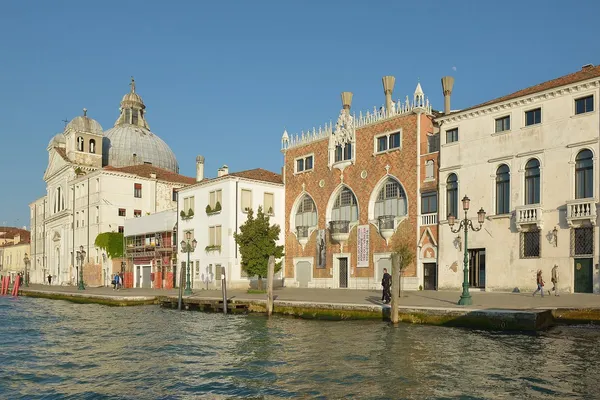
Venice is built on just over a hundred islands in a shallow lagoon, and around 50,000 people now live in the historic city. Two days are enough to see the great city – and to find the quiet one.
In this story · 10 sections
- Day 1, morning: St Mark's Basilica and the Doge's Palace
- Day 1, late morning: coffee at Florian
- Day 1, afternoon: the Grand Canal and Rialto
- Day 1, evening: La Fenice and Harry's Bar
- Day 2, morning: Tintoretto at San Rocco
- Day 2, late morning: the Accademia
- Day 2, afternoon: Peggy Guggenheim and Punta della Dogana
- The city that is emptying
- More to read
- Places
Venice is the capital of the Veneto region and is built on just over a hundred small islands in the shallow Venetian Lagoon, separated by canals and linked by more than 400 bridges. The historic city is divided into six sestieri: Cannaregio, Castello, Dorsoduro, San Marco, San Polo and Santa Croce. Around 50,000 people live there today, while most of the municipality's inhabitants live on the mainland. In the 16th century the city had more than 150,000 inhabitants.
You can't see all of Venice in two days, but you can see the most important things and still have time to get lost. The plan below divides the city in two: the first day around San Marco and the Grand Canal, the second in Dorsoduro and San Polo on the other side.
9 places
© OpenStreetMap contributors · OpenFreeMap
- 01Basilica di San MarcoCathedral · San Marco
- 02Palazzo DucalePalace and museum · San Marco
- 03Caffè FlorianCafé · Piazza San Marco
- 04Ponte di RialtoBridge · San Marco / San Polo
- 05Harry's BarBar and restaurant · San Marco
- 06Scuola Grande di San RoccoConfraternity · San Polo
- 07Gallerie dell'AccademiaArt museum · Dorsoduro
- 08Peggy Guggenheim CollectionArt museum · Dorsoduro
- 09Punta della DoganaArt museum and viewpoint · Dorsoduro
- 1063
- Work begins on the present St Mark's Basilica
- 1564–1587
- Tintoretto paints the Scuola Grande di San Rocco
- 1588–1591
- The stone Rialto Bridge is built
- 1720
- Caffè Florian opens
- 1797
- The Republic of Venice falls to Napoleon
- 1931
- Harry's Bar opens
- 2004
- La Fenice reopens after the 1996 fire
Day 1, morning: St Mark's Basilica and the Doge's Palace
Start early on Piazza San Marco, before the square fills up. St Mark's Basilica, the Basilica di San Marco, is the third church on the site and was probably begun in 1063. Its model was the 6th-century Church of the Holy Apostles in Constantinople, and the building combines Byzantine, Romanesque and Islamic features with later Gothic ones. Until the fall of the republic in 1797 it was the doge's chapel, and since 1807 it has been the patriarch's cathedral. The church holds the relics of St Mark the Evangelist, the city's patron saint.
Next to the church is the Doge's Palace, the Palazzo Ducale, in the Venetian Gothic style. It housed the government offices, a prison and the doge's residence. The first palace was built in 810, and the present one took shape in the rebuilding of 1340 and later additions. The palace has been a museum since 1923.
Day 1, late morning: coffee at Florian
Under the arcades of the Procuratie Nuove is Caffè Florian, which opened on 29 December 1720 as Alla Venezia Trionfante. It is the oldest café in continuous operation in Italy. Goldoni, Goethe and Casanova were early customers – for a long time Florian was the only café that admitted women – and later came Byron, Proust and Dickens.
Day 1, afternoon: the Grand Canal and Rialto
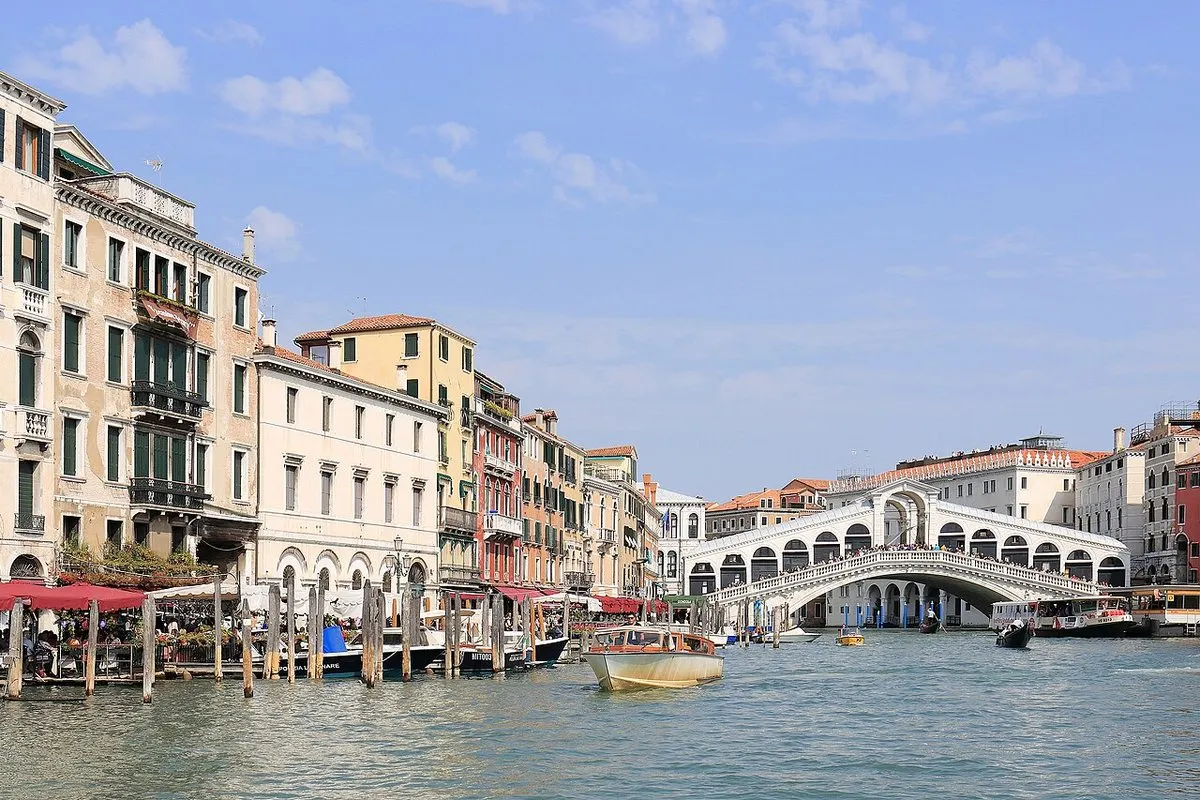
The Grand Canal winds through the city in a great reversed S, from the lagoon at Santa Lucia railway station to the basin at San Marco. It is 3.8 kilometres long, 30 to 90 metres wide and on average five metres deep, and it is lined with more than 170 buildings, most of them from the 13th to the 18th centuries: Ca' d'Oro, Ca' Rezzonico, Ca' Foscari, Palazzo Dario and Palazzo Barbaro. The best overview is from the water.
Halfway along is the Ponte di Rialto, the oldest of the four bridges across the Grand Canal. The first crossing was a pontoon bridge in the 12th century. Today's single-span stone bridge was designed by Antonio da Ponte and built in 1588–1591, with two ramps rising to a central portico and shops along the sides. The architect Vincenzo Scamozzi predicted it would collapse. It is still standing.
Day 1, evening: La Fenice and Harry's Bar
Teatro La Fenice, the Phoenix, has lived up to its name: it has burnt down three times, most recently in an arson attack in 1996, and reopened in November 2004. In the 19th century Rossini, Bellini, Donizetti and Verdi held premieres here. Since the reopening, Venice's New Year concert has been held in the theatre.
Finish at Calle Vallaresso 1323, where Giuseppe Cipriani opened Harry's Bar in 1931. According to the company's own history, Cipriani lent money to a young American, Harry Pickering, who paid it back with interest and enough extra to open a bar. The Bellini and carpaccio were both born here, and Ernest Hemingway was a regular. In 2001 the bar was declared a national landmark.
Day 2, morning: Tintoretto at San Rocco
The second day begins in San Polo, at the Scuola Grande di San Rocco. The confraternity was founded in 1478 and dedicated to San Rocco, patron saint against the plague. The building was completed in 1560. In 1564 Tintoretto was commissioned to decorate it, and between 1564 and 1587 everything in the building was painted by him or his assistants, among them his son Domenico. The paintings in the Sala dell'Albergo and the Sala Superiore are considered among his finest.
Day 2, late morning: the Accademia
Head south to Dorsoduro and the Gallerie dell'Accademia, the museum of Venetian art before the 19th century, housed in the former confraternity, church and monastery of Santa Maria della Carità. The museum owns Leonardo da Vinci's drawing Vitruvian Man, which for conservation reasons is shown for only a few weeks every six years.
Day 2, afternoon: Peggy Guggenheim and Punta della Dogana
On the Grand Canal stands the Palazzo Venier dei Leoni, an 18th-century palace where the American heiress Peggy Guggenheim lived for three decades. From 1951 she showed her collection of modern art here, bought mainly between 1938 and 1946 and spanning Cubism, Surrealism and Abstract Expressionism. After her death in 1979 the Solomon R. Guggenheim Foundation took over. With around 400,000 visitors a year, it is the most visited sight in Venice after the Doge's Palace.
The walk ends at Punta della Dogana, the point where the Grand Canal meets the Giudecca Canal. Here stand the church of Santa Maria della Salute and the old customs house, the Dogana da Mar, built in 1678–1682, with its statue of Fortune on a golden globe that turns with the wind. The customs house is now an art museum. The view towards San Marco in the evening light is one of the finest in the city.
The city that is emptying
Venice's biggest challenge is its population. Rising rents are driving residents out, and in 2016 National Geographic warned that the city was turning into an overpriced theme park. The city is also battling erosion, pollution and subsidence. If you want to visit respectfully, travel slowly, stay several nights rather than coming for the day, and walk the alleys where Venetians themselves live.
More to read
For more of Italy, spend 48 hours in Bellagio on Lake Como, head south for a perfect day in Positano and Wagner's garden in Ravello, and find all our city guides under Destinations.
Places
Basilica di San Marco
St Mark's Basilica, probably begun in 1063, with the relics of St Mark the Evangelist.
Insider tipCome early in the morning
Ponte di Rialto
The oldest of the four bridges across the Grand Canal, in stone since 1591.
Harry's Bar
Giuseppe Cipriani's 1931 bar on Calle Vallaresso, birthplace of the Bellini.
Gallerie dell'Accademia
Venetian art before the 19th century, in Santa Maria della Carità.
Peggy Guggenheim Collection
Modern art in the Palazzo Venier dei Leoni on the Grand Canal.
Punta della Dogana
The old customs house at the point where the Grand Canal meets the Giudecca Canal, next to Santa Maria della Salute.