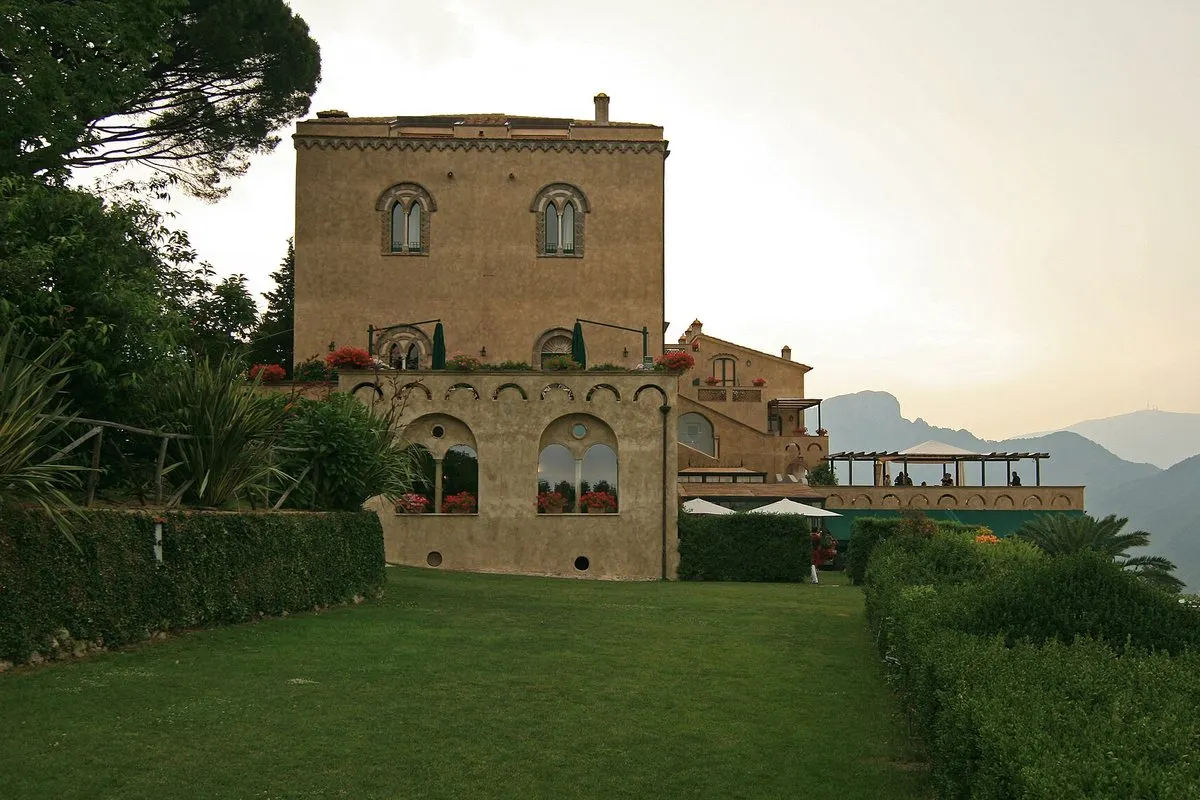
Perched high above the Amalfi Coast, 782 steps above Atrani, lies Ravello: a medieval trading town that became a village of music and gardens. Here Wagner found his Klingsor's garden and the Bloomsbury Group found their summer.
In this story · 8 sections
Ravello sits on a mountain ridge above the Amalfi Coast in the province of Salerno, exactly 782 steps above the neighbouring village of Atrani. The municipality has around 2,500 inhabitants and has been a Unesco World Heritage Site since 1997. But Ravello was once considerably larger. In the 12th century around 25,000 people lived here, and the town was an important trading centre in the maritime republic of Amalfi.
It is that wealth you see today: palaces built by the merchant families Rufolo, d'Afflitto, Confalone and Della Marra, and a cathedral with bronze doors and marble pulpits. It is also what drew a long line of artists and writers here, from Boccaccio to Gore Vidal.
4 places
© OpenStreetMap contributors · OpenFreeMap
- 01Duomo di RavelloCathedral and museum · Piazza del Duomo
- 02Villa RufoloVilla and garden · Ravello
- 03Villa CimbroneGarden and hotel · Ravello
- 04Auditorium Oscar NiemeyerConcert hall · Ravello
- 1086
- Ravello becomes a diocese and work on the cathedral begins
- 1272
- The Gospel pulpit is made for the cathedral
- 1880
- Richard Wagner visits Villa Rufolo
- 1904
- Ernest Beckett buys Villa Cimbrone
- 1953
- The first Ravello Festival
- 1997
- The Amalfi Coast, Ravello included, becomes a World Heritage Site
- 2010
- Auditorium Oscar Niemeyer opens
A town built on wool and trade
Ravello was founded in the 5th century as a refuge from the invasions that marked the end of the Western Roman Empire. Between 839 and around 1200 the town was a trading power in the Mediterranean, and wool from the surrounding area was dyed here. In 1086 Pope Victor III made Ravello a diocese in its own right, as a counterweight to the powerful Duchy of Amalfi. When Pisa sacked Amalfi in 1137 the decline began, and many moved to Naples. In 1944 the King of Italy lived in Ravello while waiting to return to Rome.
The cathedral on the square
At the heart of the town stands the Duomo di Ravello, dedicated to Santa Maria Assunta and San Pantaleone. Building began when the diocese was founded in 1086, in Romanesque style with Moorish elements. The bronze doors were installed in 1179. Inside are two pulpits in marble and mosaic: the Epistle pulpit from 1094 and the Gospel pulpit, commissioned by Nicola Rufolo and made by Nicolò di Bartolomeo of Foggia in 1272. The cathedral served as the diocese's church until 1818, has been a basilica since 1918 and a national monument since 1941. The cathedral museum is in the crypt.
A couple of alleys away is San Giovanni del Toro, a church that predates the year 1000, with a pulpit from 1200–1230. The small church of Santa Maria a Gradillo dates from the 11th century.
Villa Rufolo: Klingsor's garden
The entrance to Villa Rufolo is on the cathedral square. The villa was built in the 13th century by the wealthy Rufolo merchant family, whom Boccaccio immortalised in the Decameron. It then passed to the Confalone, Muscettola and d'Afflitto families, and around the middle of the 19th century it was bought by the Scotsman Francis Neville Reid, who restored it to its present appearance.
You enter through an archway in the entrance tower. Inside, the Torre Maggiore rises opposite the cathedral's bell tower, and below lie the upper and lower terraces, with flowerbeds that bloom for most of the year and views over the coast and the Gulf of Salerno. There is also a raised courtyard resembling a cloister, and a few rooms that form a small museum.
In 1880 Richard Wagner visited the villa and was so taken with it that he pictured it as Klingsor's garden in the second act of Parsifal. According to tradition, he declared: here is Klingsor's magic garden. In memory of the visit, a Wagner concert is held every year in the villa's lower garden.
Villa Cimbrone: the Terrace of Infinity
A walk south through the town ends at Villa Cimbrone, on the Cimbronium cliff. The villa is recorded from the 11th century and has belonged to the noble Accongiogioco and Fusco families and to the convent of Santa Chiara. In 1904 it was bought by the Englishman Ernest William Beckett, later Lord Grimthorpe, who with Nicola Mansi of Ravello rebuilt it with battlements, terraces and a cloister in a mix of neo-Gothic, Moorish and Venetian styles. Most of what you see today was brought from other buildings.
The garden runs along the edge of the cliff and ends at the Terrazza dell'Infinito, the Terrace of Infinity, lined with marble busts. The historian Ferdinand Gregorovius described it as early as 1861. Beckett is buried by the Temple of Bacchus in the garden. His daughter Lucy bred roses here, among them the Rose of Ravello in the 1930s.
The villa became a favourite of the Bloomsbury Group – Virginia and Leonard Woolf, E.M. Forster, John Maynard Keynes and Lytton Strachey. D.H. Lawrence, T.S. Eliot, Henry Moore and Winston Churchill came here, and Greta Garbo stayed several times in the late 1930s with the conductor Leopold Stokowski. A plaque recalls their 1938 visit. In John Huston's 1953 film Beat the Devil, a love scene between Humphrey Bogart and Jennifer Jones is played out on the terrace. Today the villa is a hotel, and the garden is open to the public.
The festival and the auditorium
The Ravello Festival has been held every summer since 1953, when the town's authorities decided to use Wagner's visit to attract visitors in the difficult post-war years. It is still known as the Wagner Festival, but has grown into almost two months of orchestras, chamber music, jazz, dance and exhibitions.
To extend the season, the Auditorium Oscar Niemeyer was built, based on a sketch from the Brazilian architect's studio in Rio de Janeiro dated 23 September 2000. Construction ran from October 2008 to January 2010, and the first concert, on 31 January 2010, was opened by Lucio Dalla.
An artists' village
The list of visitors is long: Edvard Grieg, M.C. Escher, André Gide, Joan Miró, Truman Capote, Tennessee Williams, Graham Greene, Jacqueline Kennedy and Leonard Bernstein. La Rondinaia, the Swallow's Nest, a villa built on a cliff face in the 1930s, was Gore Vidal's Italian home until 2004.
More to read
Further along the coast, spend a perfect day in Positano, cross the bay to Capri on two levels, and find more places to go under Destinations at metromode.co.
Places
Duomo di Ravello
The cathedral from 1086, with bronze doors from 1179 and two pulpits in marble and mosaic.
Insider tipThe cathedral museum is in the crypt
Villa Rufolo
The Rufolo merchant family's 13th-century villa, where Wagner saw Klingsor's garden.
Insider tipWagner concert in the lower garden every year
Villa Cimbrone
Beckett's villa and clifftop garden, with the Terrazza dell'Infinito.
Insider tipThe garden is open to the public
Auditorium Oscar Niemeyer
Concert hall based on Oscar Niemeyer's sketch, opened in 2010.