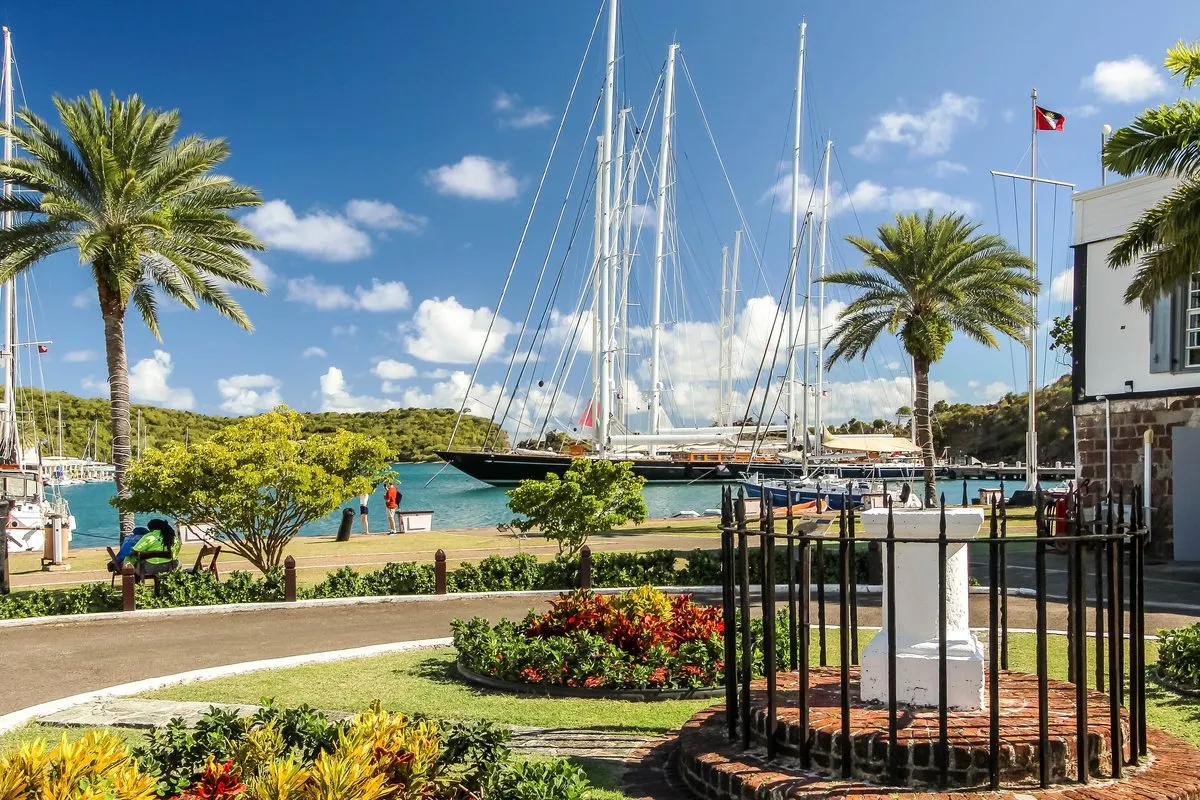
On Antigua's south coast, a hurricane-proof natural harbour became the Royal Navy's Caribbean base, and the young Horatio Nelson called it an infernal hole. Today it is the only continuously working Georgian dockyard in the world – and a centre of Caribbean yachting.
In this story · 6 sections
Antigua is the most populous island of Antigua and Barbuda, a Leeward Islands nation independent since 1 November 1981. Columbus named it in 1493, probably after the Virgen de la Antigua mural in Seville Cathedral; its Indigenous name, Waladli, means roughly our own. Tourism is the backbone of its economy, and the capital, St John's, in the north-west, receives the cruise ships.
The island's historic heart, though, is in the far south. English Harbour is one of the largest deep-water protected harbours in the Eastern Caribbean, and together with neighbouring Falmouth Harbour it has become one of the region's great sailing centres. On shore stands Nelson's Dockyard.
01A harbour that hurricanes could not reach
After the English colonised Antigua in 1632, the Royal Navy began using English Harbour as a safe haven: it was well placed to watch the neighbouring islands, and its shape sheltered ships from storms. Its reputation was sealed in September 1723, when a hurricane drove 35 ships ashore in other Antiguan ports while the two naval vessels moored here came through unharmed. Fort Berkeley had guarded the entrance since 1704; in 1725 the island's legislature assigned the harbour to the Crown for naval use.
The first small dockyard, St Helena, was built on the eastern side. From the mid-1740s the main yard rose on the western side, built by enslaved Africans sent from nearby plantations. By the end of the Napoleonic Wars the harbour held twin dockyards, a victualling yard, an ordnance yard and a naval hospital, with the commissioner's residence, Clarence House, on the hillside above.
02Nelson's infernal hole
Captain Horatio Nelson arrived in July 1784 as senior officer of the Northern Division of the West Indies Station, commanding HMS Boreas, and stayed until 1787. He was not charmed: he called the harbour an "infernal hole" and complained that the islanders were as great rebels as any in America. In December 1786 he was joined by Prince William Henry, the future William IV, in command of HMS Pegasus. The Royal Navy abandoned the dockyard in 1889, but it kept Nelson's name.
03Walking the dockyard
Today the restored eighteenth- and nineteenth-century buildings form Nelson's Dockyard National Park, part of the Antigua Naval Dockyard and Related Archaeological Sites World Heritage Site. Wander the wharves among the stone storehouses and the Saw Pit Shed; the old Copper and Lumber Store and the former Ordnance Yard now house hotels, and the marina is full of yachts. It is, remarkably, still a working dockyard – the only Georgian one left anywhere.
04Shirley Heights
Above the harbour to the east rise the fortifications of Shirley Heights, planned by Governor Shirley in 1782 and built between 1788 and 1793. Fort Shirley was garrisoned into the 1830s and abandoned in 1854. Climb up in the late afternoon for the classic view over English and Falmouth harbours.
05The sailing calendar
English Harbour comes alive for its regattas. Antigua Sailing Week, at the end of April and the beginning of May, brings boats and crews from around the world; the Antigua Classic Yacht Regatta and the Antigua Charter Yacht Meeting are also based at the dockyard, and every December one of the largest charter yacht shows fills the harbour with superyachts.
06Planning
Stay in or near English Harbour and Falmouth to be close to the dockyard and the sailing. For more islands and cities, see our destinations, the Metro Mode home page and our list of hotels worth a single night.