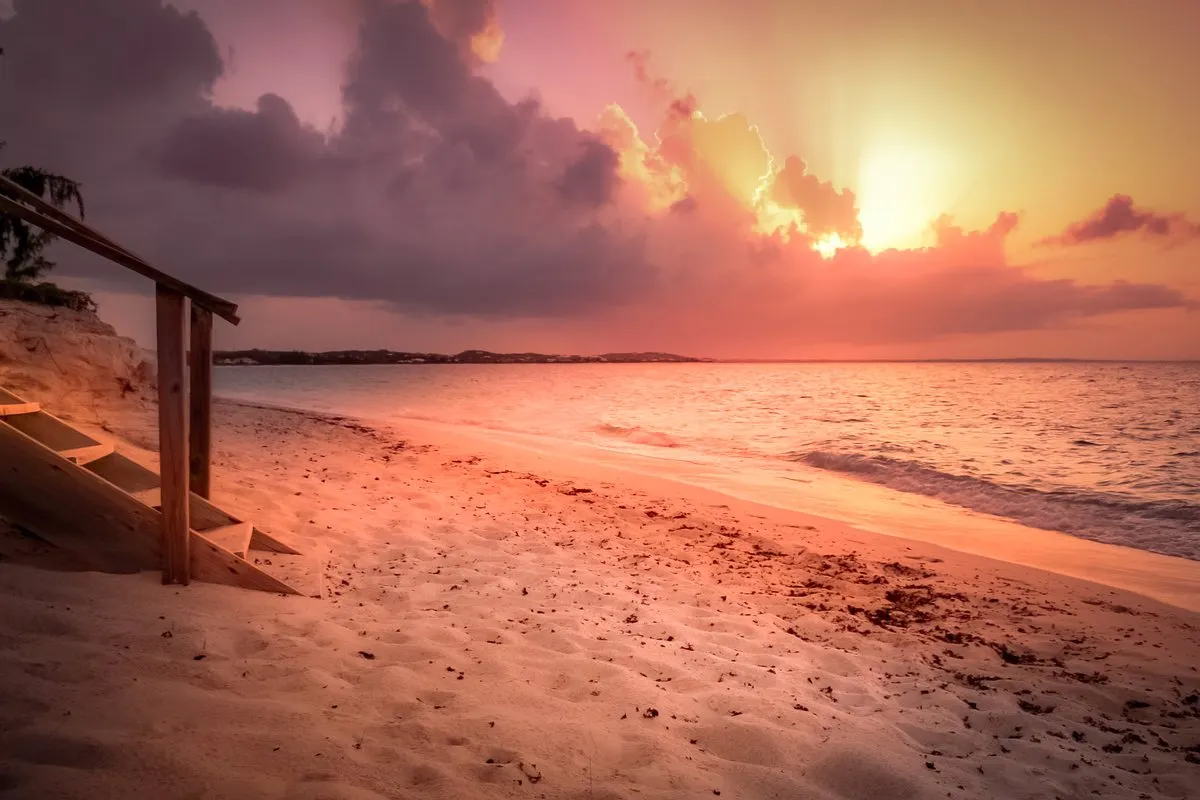
In 1964 Providenciales had no roads, no electricity and not a single wheeled vehicle. Today it is the busiest island of the Turks and Caicos, with a famous beach on one side and a turquoise lagoon of mushroom islets on the other. A guide to Provo.
In this story · 6 sections
The Turks and Caicos Islands are a British Overseas Territory in the Lucayan Archipelago, south-east of the Bahamas and north of Hispaniola. The name Caicos comes from a Lucayan word meaning string of islands; the Turks Islands are named after the Turk's cap cactus, whose red crown resembles a fez. The capital, Cockburn Town, is on Grand Turk, but the heart of the territory today is Providenciales, an island in the north-west Caicos where most residents live and most visitors stay.
Provo's rise has been startlingly fast. As recently as 1964 it had no roads, water, telephones, electricity or a single wheeled vehicle. Its first developer, Provident Ltd, flew prospective buyers in twice a week from Florida in a wartime DC-3 and in 1967 built the island's only hotel, the Third Turtle Inn. Today Provo is the most developed of the islands, with resort hotels, an 18-hole golf course and a steady stream of retirees from around the world.
01Lucayans, salt rakers and Loyalists
Arawakan-speaking people crossed from Hispaniola between AD 500 and 800 and, with Taíno from Cuba, became the Lucayans. By about 1513 Spanish slave raids and disease had emptied the islands, which stayed deserted until the seventeenth century, when Bermudian salt collectors began to visit with enslaved Africans. Pirates used the cays as hideouts, and after the American War of Independence Loyalists arrived to plant cotton. The islands were governed for many years through Bermuda, the Bahamas and Jamaica, and have had their own governor since the Bahamas became independent in 1973.
02Grace Bay
Provo's resorts are concentrated along Grace Bay on the north shore, a long sweep of beach that has drawn many luxury condominiums in recent years. Before tourism, The Bight, on Grace Bay, was one of the island's three small settlements, alongside Blue Hills and Five Cays. The bay is the natural base for a first visit, with the reef and the open sea in front of you.
03Chalk Sound National Park
The western half of the island is mostly barren wilderness, and it holds Provo's finest natural sight: Chalk Sound National Park, a long bay south-west of Downtown whose water is a uniform turquoise, studded with countless tiny, mushroom-shaped islets. Explore it by kayak or paddleboard. Further west, Northwest Point Marine National Park takes in nearby reefs and saline lakes that attract breeding and migrating waterfowl.
04Long Bay, pirates and a Loyalist plantation
On the southern, windward side, Long Bay Beach is still largely undeveloped, and its steady wind and isolation have made it a kiteboarding destination. Inland, the island's hills and ridges are carpeted with prickly pear and scrub. History is scattered here too: traces of Caribbean piracy at Osprey Rock and Sapodilla Hill, and the ruins of Cheshire Hall, a sisal and cotton plantation owned by the Loyalist Thomas Stubbs from the 1790s until 1810.
05Out to the cays
Providenciales is surrounded by uninhabited cays, easily reached by chartered boat or excursion, and lies close to a common migration route of the humpback whale. A day on the water is the best way to understand what string of islands means.
06Getting around
Providenciales International Airport is close to Downtown and Kew Town. There is no public transport, so hire a car or use taxis; the Leeward Highway runs east to west across the island. For more, see our destinations, the Metro Mode home page and our list of hotels worth a single night.