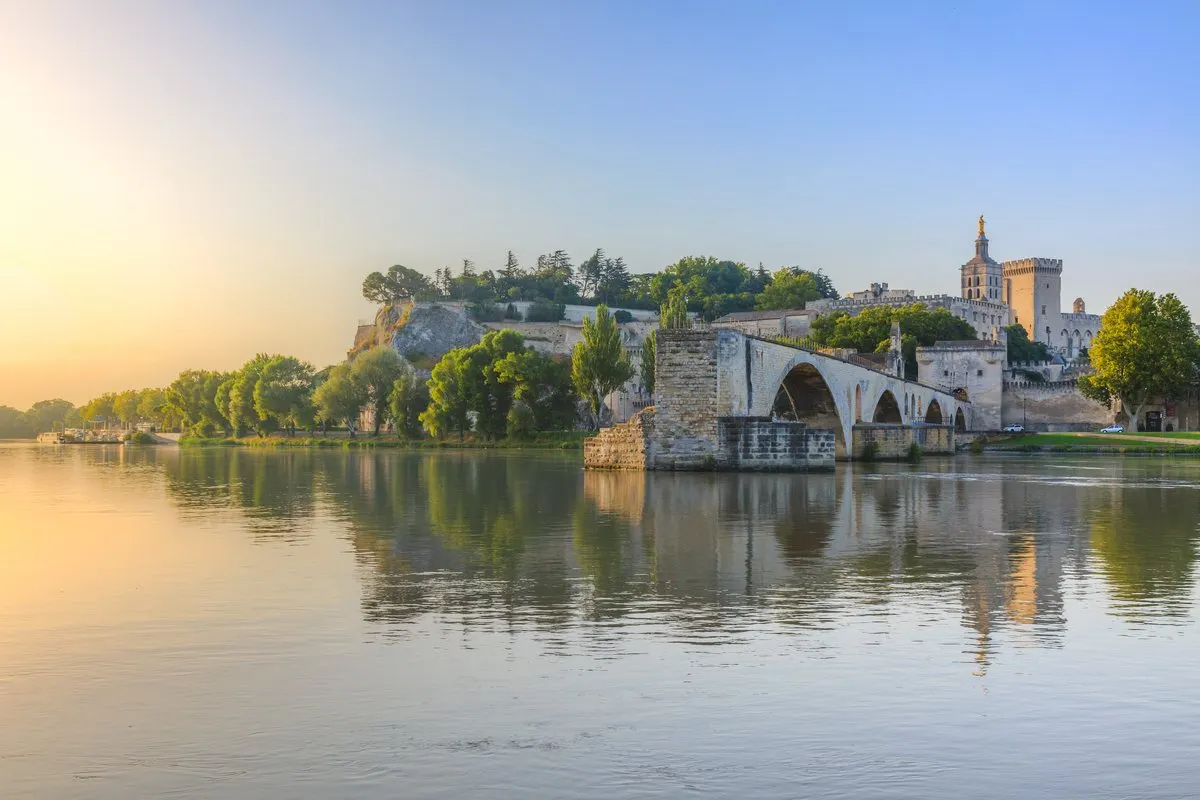
For most of the 14th century, Avignon was the centre of Christendom. The popes left behind a palace considered the largest Gothic palace in Europe, half a bridge, and a city that every July fills with theatre – since 1947.
In this story · 6 sections
Avignon in Vaucluse lies on the Rhône, within an almost complete medieval ring wall. Today it is a city with around 92,000 inhabitants, a university and a TGV station. But during the 14th century, Avignon was the capital of Christendom: the popes left Rome and governed the Church from here for nearly seventy years. What they built is still the heart of the city.
This is the story of how Avignon became a papal city – and of how the city today lives on both its heritage and its theatre. The property market can be found on VERA PI's page about Avignon.
Avignon through the years
- 1177–1185
- First bridge over the Rhône
- 1234
- Work begins on the stone bridge with 22 arches
- 1334
- Benedict XII elected; the old palace is built
- 1342
- Clement VI elected; the new palace is built
- 1947
- Jean Vilar starts the festival
- 1995
- World Heritage Site
01The popes arrive
In the early 14th century, Rome was politically unstable, and Pope Clement V settled in the Avignon area. His successors stayed on. Six conclaves were held in the palace, and they elected Benedict XII in 1334, Clement VI in 1342, Innocent VI in 1352, Urban V in 1362, Gregory XI in 1370 and Benedict XIII in 1394. The last of them, Benedict XIII, was an antipope during the Great Schism, when the Church had two popes at the same time, one in Rome and one in Avignon.
02Palais des Papes
The palace is in fact two buildings in one. The old palace was built by Benedict XII on the Rocher des Doms, the new one by Clement VI, the most lavish of the popes in Avignon. The architects were Pierre Peysson and Jean de Louvres, and the decoration was done by Simone Martini and Matteo Giovannetti from the Sienese school. The papal library had over 2,000 volumes and was then the largest in Europe, attracting, among others, Petrarch.
With 15,000 square metres of floor space, the palace is considered the largest Gothic palace in Europe. Today it receives around 650,000 visitors a year. In 1995, it became a World Heritage Site together with the cathedral Notre-Dame des Doms, the bridge and other parts of the historic city centre. Go early in the morning, and then go up to the garden on the Rocher des Doms for the view over the Rhône.
03Pont Saint-Bénézet – the bridge that stops halfway
The bridge is older than the popes. According to legend, it was built by the shepherd Bénézet, and a first bridge was built between 1177 and 1185. It was destroyed in 1226, when Louis VIII of France besieged the city, and from 1234 it was rebuilt in stone with 22 arches and a length of around 900 metres.
The arches collapsed every time the Rhône flooded, and the maintenance became too costly. The bridge was abandoned in the mid-17th century, and a flood in 1669 took most of it away. Today, four arches and the gatehouse remain on the Avignon side, and the bridge ends in the middle of the river. It has been a World Heritage Site since 1995.
041947: Jean Vilar and the festival
Modern Avignon begins in 1947. The art critic Christian Zervos and the poet René Char organised an exhibition of contemporary art in the palace's great chapel and invited the actor and director Jean Vilar to stage theatre. Among other things, he chose Shakespeare's Richard II, which was then almost unknown in France. This was the start of the Festival d'Avignon, which today is the oldest festival in France still held.
Every July, the official festival, the "In", is held in venues including the Cour d'honneur of the Palais des Papes. Alongside it runs the "Off", with hundreds of performances in theatres, churches and courtyards across the whole city – in 2008 around 950 performances were staged over three weeks. During the festival the city is packed; for the rest of the year it is quiet.
05Contemporary art and the town palaces
Avignon is also a city of art today. In the Hôtel de Caumont, a town palace begun in 1720 by the architect Jean-Baptiste Franque, the gallerist Yvon Lambert has been showing his collection of contemporary art, Collection Lambert, since July 2000, with works by, among others, Jean-Michel Basquiat, Cy Twombly, Nan Goldin and Anselm Kiefer. It is one of the finest collections of its kind in the south of France.
06Avignon according to VERA PI
Avignon is one of the most affordable cities in Provence. According to VERA PI, 8,977 properties were sold from January 2021 to June 2026, with a median of 2,279 euros per square metre for flats and 2,538 euros for villas and houses. Only 6 per cent of the properties are second homes. For comparison, see VERA PI's page on the wine village of Châteauneuf-du-Pape north of the city, where the popes had their summer residence.
More of Provence: Arles – the Romans, Van Gogh and Gehry's silver tower. More destinations can be found among metromode.co's destinations, and with Metro Mode Camera you get the story behind every façade you walk past.