Twelve brick palaces fanned out around an English church, built for industrialists and publishers and today home to embassies. The Diplomat Town in Östermalm is Stockholm's most exclusive quarter – and one of the city's most beautiful walks.
In this story · 6 sections
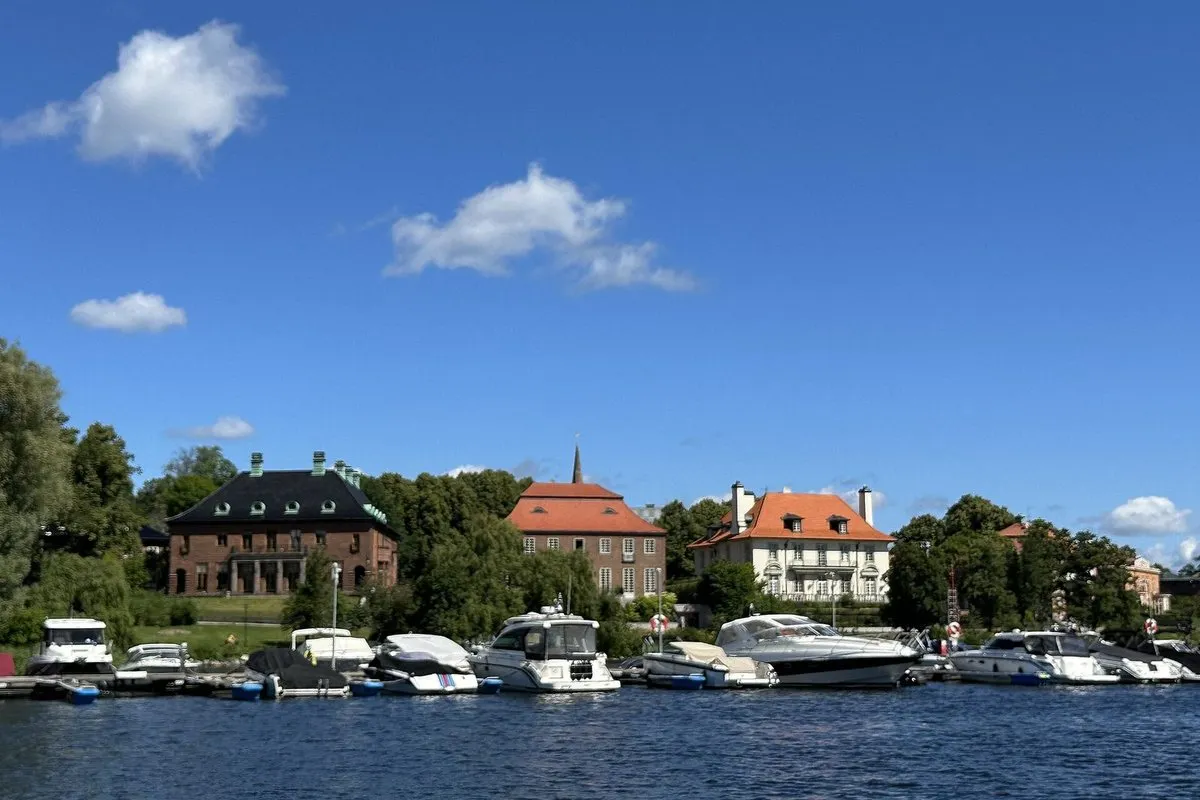
From the water at Djurgårdsbrunnsviken, they appear in a row: a brick palace with a dark, steep roof, a red house with a spire behind it, and a light-coloured villa with an orange tile roof, all nestled in greenery down to the waterfront promenade. This is Diplomatstaden, the Diplomat Town, a small area in Östermalm with twelve palace-like villas from the 1910s and 1920s, gathered in a semicircle around the English Church. The villas here have fetched some of the highest prices ever paid for homes in Sweden – and they are considered among the city's most thoughtfully designed architecture from the early part of the last century.
Diplomatstaden (the Diplomat Town)
Walk · Östermalm
© OpenStreetMap contributors · OpenFreeMap
- Address
- Laboratoriegatan, Stockholm
- Town plan
- Per Olof Hallman, 1911–1914
- Villas
- Twelve, built during the 1910s and 1920s
- First villa
- Villa Geber, 1913 (Ragnar Östberg)
- Architects
- Östberg, Tengbom, Cyrillus Johansson, Erik Josephson, Carl Westman
- Record sale
- The Bünsow villa, SEK 115 million (2007)
Residential district from the 1910s and 1920s by Östberg, Tengbom and Westman, today largely embassies.
01From gunpowder laboratory to villa town
The place has an unexpected history. In the early 1400s, there was a royal farm here, and in the 1670s, a laboratory for the manufacture of gunpowder and ammunition moved into the building. In 1716, the laboratory exploded. The street names Laboratoriegatan and Kruthusplan still recall that era.
In 1911, the architect Ferdinand Boberg designed a monumental Nobel Palace for the site of today's Nobel Park. It was never built, but the names Nobelparken and Nobelgatan live on. Instead, planning began for exclusive residential buildings. Stockholm's city planning director Per Olof Hallman – the same man who designed Lärkstaden – laid out the villa quarters between 1911 and 1914 as a fan around the English Church, and the plan stipulated that the facades should mainly be of red brick. This gave the area its uniform character. During the summer of 1912, the stands for the Olympic rowing events stood here; when they were demolished, construction of the villas began.
02The name that came before the diplomats
The blocks were given names such as Ambassadören and Diplomaten, and the name Diplomatstaden can already be found in writing in 1919. The idea seems to have been that foreign legations would establish themselves here. Yet eleven of the twelve villas were built by private individuals – only the British residence was built for a state. The developers were among the wealthiest Swedes of the time: the industrialists Berndt August Hjorth (Bahco) and Carl Wikström, the publisher Erik Åkerlund, the prime minister Ernst Trygger, and the Bonnier, Bünsow and Josephson families.
Insider tipThe villas are best seen from the promenade at Djurgårdsbrunnsviken.
It took time before the diplomats arrived. In 1924, Electrolux chief Axel Wenner-Gren bought the Tillberg villa, which became known for its lavish parties. In the 1930s, foreign states' interest awoke, and among the first was the USA, which from 1935 rented Villa Åkerlund for its envoy. By the end of the 1960s, half of the properties were used for diplomatic purposes, and today most of the villas are owned by foreign states.
03Palaces in a time of housing shortage
The contrast with the rest of the city was enormous. The villas were built over three decades marked by war, economic boom and depression – and by a severe housing shortage in Stockholm. In 1917, towards the end of the First World War, the district judge Knut Tillberg commissioned a villa with nearly 25 rooms. The same year, the Home Exhibition (Hemutställningen) at Liljevalchs konsthall showed how a family with children could live in a single room with a stove – kitchen, living room and bedroom in one. Between 1917 and 1924, around 2,500 emergency wooden dwellings were built in Stockholm. The Trygger, Bünsow and Tillberg villas were all planned during or shortly after the war, in a time of material shortages and rationing.
04The architects
The villas were designed by some of the most celebrated architects of their time: Ragnar Östberg, Ivar Tengbom, Cyrillus Johansson, Erik Josephson and Carl Westman. The first house was Villa Geber at Laboratoriegatan 6 from 1913, designed by Östberg at the same time as he was working on the City Hall – and the similarities are clear, with a courtyard like a roofless miniature of the Blue Hall and a well with figures by Carl Milles. The villa's floor plan is unusual: the entire eastern side is cut at an angle, and the offset walls give the rooms a slight tension that is said to have influenced architects such as Gunnar Asplund. The British Residence was designed in 1913 by the British architect Sir Richard Allison and has a light, almost white render that contrasts with the brick. The Tillberg villa stands out with its old rose tone. One of the last villas was Villa Bonnier from 1927, also by Östberg.
The English Church was moved here in 1913 from Wallingatan in Norrmalm. Down by the water's edge, level with Kruthusplan, stands the bronze sculpture The Resting Diana, a copy of an original from the mid-16th century by the French artist Jean Goujon.
05Record prices
Two of the villas have been reported as record sales for private homes in Sweden: the Bünsow villa for SEK 115 million in 2007 and Villa Geber for SEK 70 million in 2001. Villa Geber was also called Villa Dagmar during the time Consul General Karl Bergsten and his wife Dagmar owned it – the same family that was behind Hotel Diplomat. None of the privately built villas is owned today by the original family.
06How to do the walk
The Diplomat Town is a residential and embassy district, and most of the villas are private or diplomatic properties not open to visitors. However, the walk around the blocks is free. Start at Nobelparken, walk along Nobelgatan and Laboratoriegatan, and then make your way down to the promenade along Djurgårdsbrunnsviken, where the villas are seen at their best – just as in the picture above. Please respect barriers and security around the embassies.
See the streets in VERA PI's street guide to Laboratoriegatan and to Nobelgatan, explore the rest of Östermalm and continue towards Djurgården with our guide A day on Djurgården. And if you want to know who designed the villa in front of you: point your phone at the façade with Metro Mode Camera.