On 10 August 1628, Sweden's most powerful warship sank before the eyes of a large crowd, just 120 metres from the shore. 333 years later, it was raised almost intact. The story of Vasa – and how you can experience the ship today.
In this story · 7 sections
It was a clear and calm afternoon on 10 August 1628. Along Stockholm's shores, hundreds, perhaps thousands, of people had gathered to watch the king's new warship set sail. The gunports stood open, a salute was fired, and four of the ten sails were set. Then came a gust of wind, and the ship heeled over. It righted itself – but the next gust pushed it down so deep that water poured in through the gunports. Between four and five o'clock in the afternoon, the royal ship Vasa capsized and sank off Beckholmen, 120 metres from the shore, at a depth of 32 metres. According to contemporary reports, between 30 and 50 people drowned.
Today the same ship stands, almost complete, in a museum hall on Djurgården. It is one of Stockholm's most visited attractions – and one of the world's most remarkable stories of a failure that became a treasure.
Vasa Museum (Vasamuseet)
Museum · Djurgården
© OpenStreetMap contributors · OpenFreeMap
- Address
- Galärvarvet, Djurgården, Stockholm
- Ordered
- 1625
- Sank
- 10 August 1628, at a depth of 32 metres
- Located
- 1956 (Anders Franzén and Per Edvin Fälting)
- Salvaged
- 24 April 1961
- Preservation
- 17 years of spraying, 9 years of drying
- Vasa Museum inaugurated
- 15 June 1990
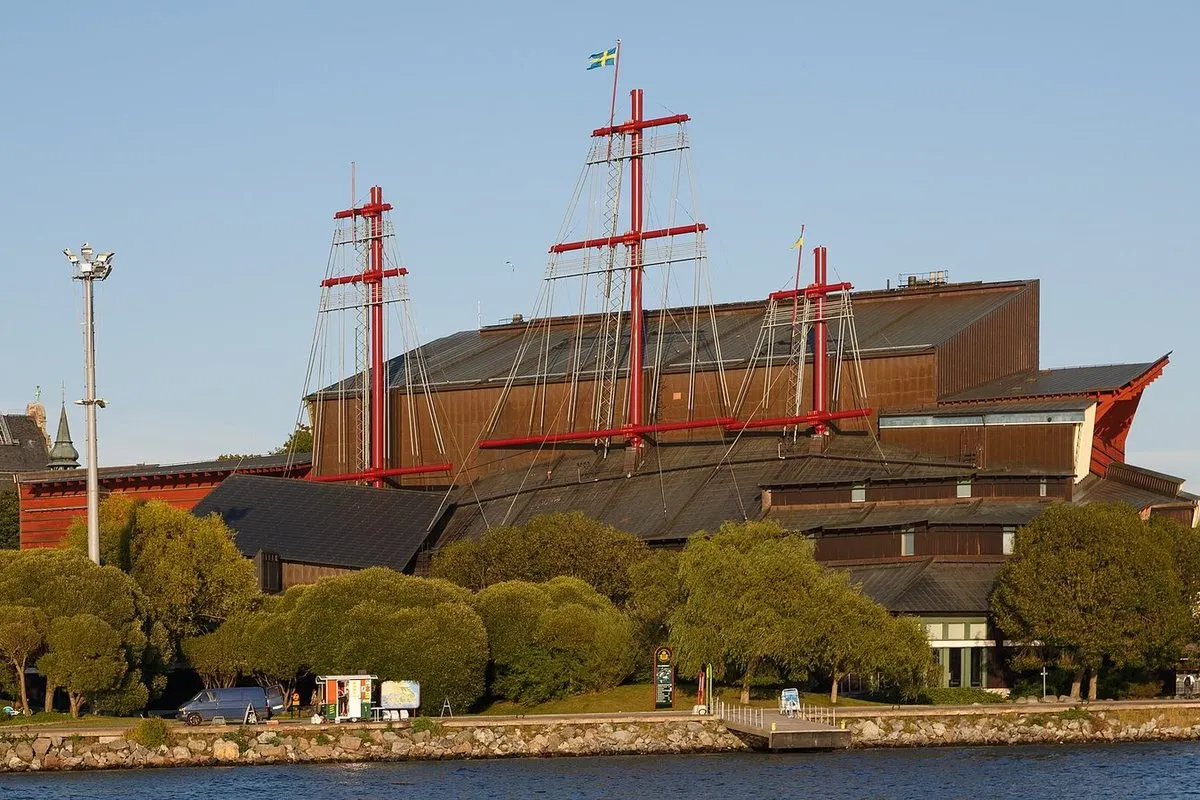
The warship Vasa from 1628 in a hall built over a dry dock from 1878.
01A ship for a warrior king
In the early 17th century, Sweden was on its way to becoming the dominant power around the Baltic Sea, and Gustav II Adolf had been at war with Poland since 1625. He needed a strong navy. The Vasa was commissioned in 1625, together with three other ships, from the Stockholm shipyard on what was then called Skeppsholmen – today Blasieholmen. The shipbuilder was the Dutchman Henrik Hybertsson, but he died in the spring of 1627 before the ship was finished, and the work was completed under his assistant Henrik "Hein" Jacobsson.
The navy was in poor condition, the Thirty Years' War was going badly for the Protestant side, and the main rival for supremacy at sea was Denmark under Christian IV. When the navy also lost ten ships in a storm, the king wrote to Admiral Clas Fleming and demanded that the construction be sped up. During construction, the king himself sent new measurements to the shipyard, and the Vasa was given a keel length of 135 feet. She was built in the Dutch manner, with a relatively flat bottom, and was one of the first Swedish ships with two continuous gun decks. That made her one of the country's largest and most heavily armed warships – and, as it would turn out, far too unstable.
02Hundreds of sculptures in bold colours
The Vasa was not meant to win wars alone. She was meant to display Sweden's power. The ship was adorned with hundreds of sculptures that paid tribute to the king's wisdom and martial fortune while also being intended to frighten the enemy: figures from ancient mythology and history and from the Old Testament, mermaids, tritons, wild men and monsters. The sculptures accounted for a significant part of the cost and were so heavy that they, to some extent, impaired the ship's manoeuvrability.
Insider tipCool in the ship hall all year round – 18 to 20°C.
For a long time, it was believed that the Vasa had been blue and gleaming with gold. Today, we know better: the sculptures were painted in bright, vivid colours, sometimes enhanced with genuine gold leaf, against a red background. The Vasa's painted sculptures are among the last traces of the medieval sculptural tradition before the Baroque took over with heavy full gilding.
03Why she sank
The direct cause was that Vasa was too unstable to sail in stronger wind. She had failed a stability test at the quay, but was allowed to sail anyway – the king wanted her in the war against Poland. At the inquiries afterwards, no one could be convicted, since the king himself had approved the measurements.
04333 years at the bottom
After several unsuccessful salvage attempts in the 17th century, the Vasa was largely forgotten. In 1956, amateur researcher and engineer Anders Franzén, together with diver Per Edvin Fälting, succeeded in finding the ship's exact position, and on 24 April 1961 the Vasa was raised above the surface of the water.
The reason she was so well preserved is the Baltic Sea. The shipworm, which rapidly breaks down wood in sea water, cannot survive in the Baltic's brackish and cold water, and the polluted, oxygen-poor bottom water in Stockholm's harbour also kept other decomposers away. Inside and around the ship, thousands of objects were found – clothes, weapons, cannons, tools, coins, food and drink, and six of Vasa's ten sails – as well as the remains of more than a dozen people. Vasa is the only 17th-century ship that has been salvaged in virtually complete condition.
05Saving a ship made of wood
The salvage was only the beginning. Had the wood been allowed to dry, it would have shrunk and cracked, so the ship was sprayed with the preservative polyethylene glycol for 17 years, open to visitors in the temporary museum Wasavarvet, and was then left to dry slowly for a further nine years. The work continues: around the year 2000 it was discovered that sulphur in the wood forms sulphuric acid, and to slow the degradation the ship hall is now kept constantly at 18–20°C and around 55 per cent humidity. That is why it is cool in the hall.
06The Vasa Museum
The present museum, Vasamuseet, was inaugurated on 15 June 1990 by King Carl XVI Gustaf. It was designed by Månsson & Dahlbäck and built across the naval dockyard's large dry dock from 1878 – Vasa lies in the dock itself. Outside, museum ships are moored, among them the lightvessel Finngrundet and the icebreaker Sankt Erik. Between 1961 and 2011, Vasa attracted over 29 million visitors, and the museum had over 1.5 million visits in 2019, making it one of Sweden's most visited museums.
07How to experience Vasa at its best
Arrive early in the day or late in the afternoon, outside the peak summer weeks, if you want to see the ship in peace and quiet. Take your time to see it from different angles – the breadth of the hull, the rigging and the sculptures on the stern. The museum is located on Djurgården, and the walk there along Strandvägen is part of the experience. Read our plan for a day on Djurgården and the island's history in Djurgården: from royal hunting ground to Stockholm's green island, see the island in VERA PI's guide to Djurgården, plan your walk along Strandvägen and find everything on Metro Mode's Stockholm map.