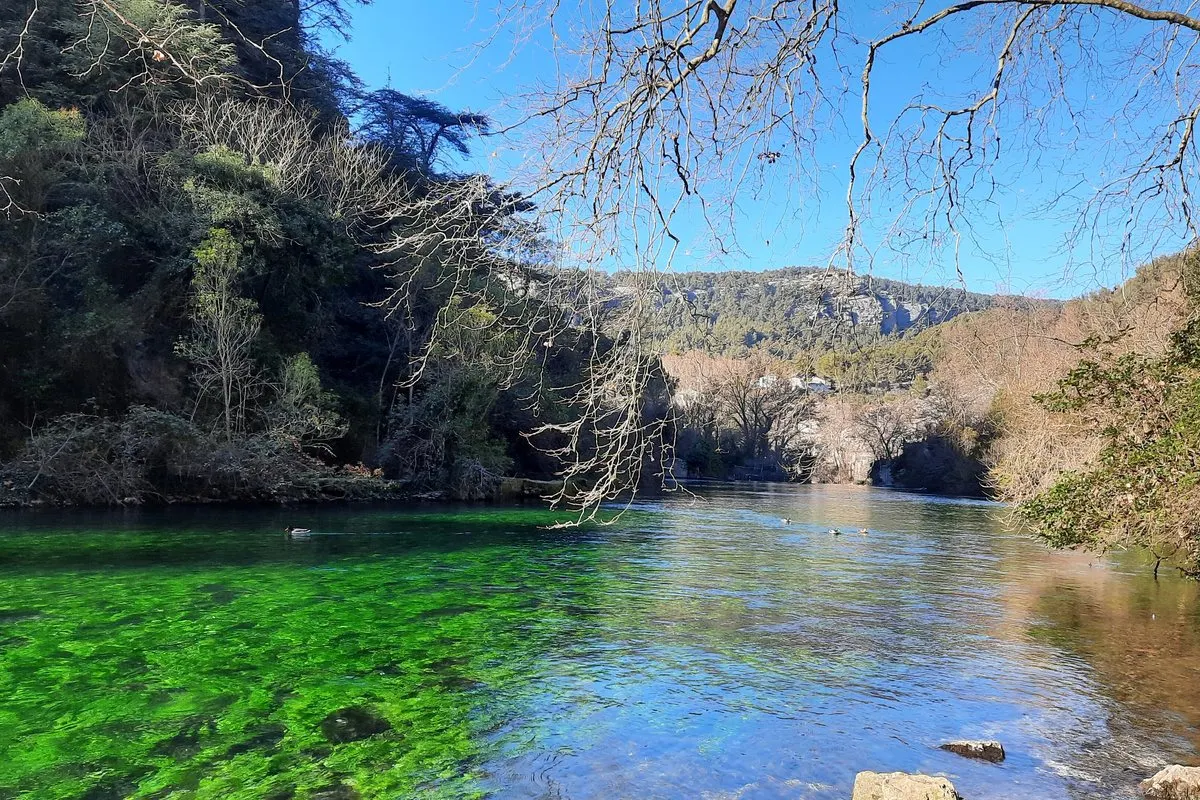
At the end of a closed valley, the Sorgue rises from a pool beneath a 230-metre cliff – the largest spring in France, so deep that only robots have reached its floor. Petrarch lived beside it for fifteen years and called them the happiest of his life.
In this story · 3 sections
Fontaine-de-Vaucluse is a village of about 600 people at the foot of the Monts de Vaucluse, between Saumane-de-Vaucluse and Lagnes and not far from L'Isle-sur-la-Sorgue. It was once called simply Vaucluse – from the Latin vallis clausa, the closed valley – and gave its name to the whole department. Everything here turns on the spring at the end of the valley, the source of the Sorgue. For the town downstream, see VERA PI's L'Isle-sur-la-Sorgue guide.
2 places
The spring
The fountain wells up at the foot of a limestone cliff 230 metres high. It is the largest spring in metropolitan France and ranks fifth in the world, with an annual flow of 630 to 700 million cubic metres – an average of 21 cubic metres a second, seven times all the drinking water supplied in the Vaucluse. It is the only outlet of an underground basin of 1,100 square kilometres that gathers the waters of Mont Ventoux, the Monts de Vaucluse, the Plateau d'Albion and the Montagne de Lure, and it has given its name to a type of karst spring, the “vauclusian” spring. In March the flow surges for about five weeks and the Sorgue floods; the mechanism is still not fully understood.
A century of diving
On 27 March 1878 Nello Ottonelli, in a heavy diving suit, reached 23 metres. In 1946 Jacques-Yves Cousteau and another diver nearly died in the attempt with the new aqualung; Cousteau later reached 46 and then 74 metres, the limit for air. With mixed gases, Claude Touloumdjian went to 153 metres in 1981 and Jochen Hasenmayer to 205 metres in 1983. Robots did the rest: in 1985 one touched down at 305 metres, and in 1989 the Spélénaute reached 315 metres, the deepest point known. Divers from the local caving society have also recovered some 1,600 coins and objects, offerings dating from the 1st century BC to the 5th century AD.
Petrarch's valley
Petrarch first saw the spring in 1313, aged nine, and later recalled thinking: here is a place made for me. As an adult he settled here for some fifteen years, writing that he had spent his best years and happiest moments in Vaucluse; he left in 1353 after the death of his son. Over the centuries the valley became a literary pilgrimage, visited by Madeleine de Scudéry, Casanova, Lamartine, Chateaubriand, George Sand and Stendhal.
The Musée-bibliothèque François Pétrarque, founded in 1927 for the 600th anniversary of the poet's meeting with Laura and opened in 1928, stands on the left bank of the Sorgue on the presumed site of his house. It is devoted to Petrarch and to the 20th-century poet René Char, and holds the Musée de France and Maisons des Illustres labels. A column to Petrarch was raised in the 18th century, and the village is twinned with Arquà Petrarca, where he died.
For more of the Vaucluse, see VERA PI's Fontaine-de-Vaucluse guide, its Avignon page and our destination guides.
Fontaine de Vaucluse
Source of the Sorgue
France's biggest spring, beneath a 230-metre cliff.
Musée-bibliothèque François Pétrarque
Petrarch and René Char
On the presumed site of Petrarch's 14th-century house.