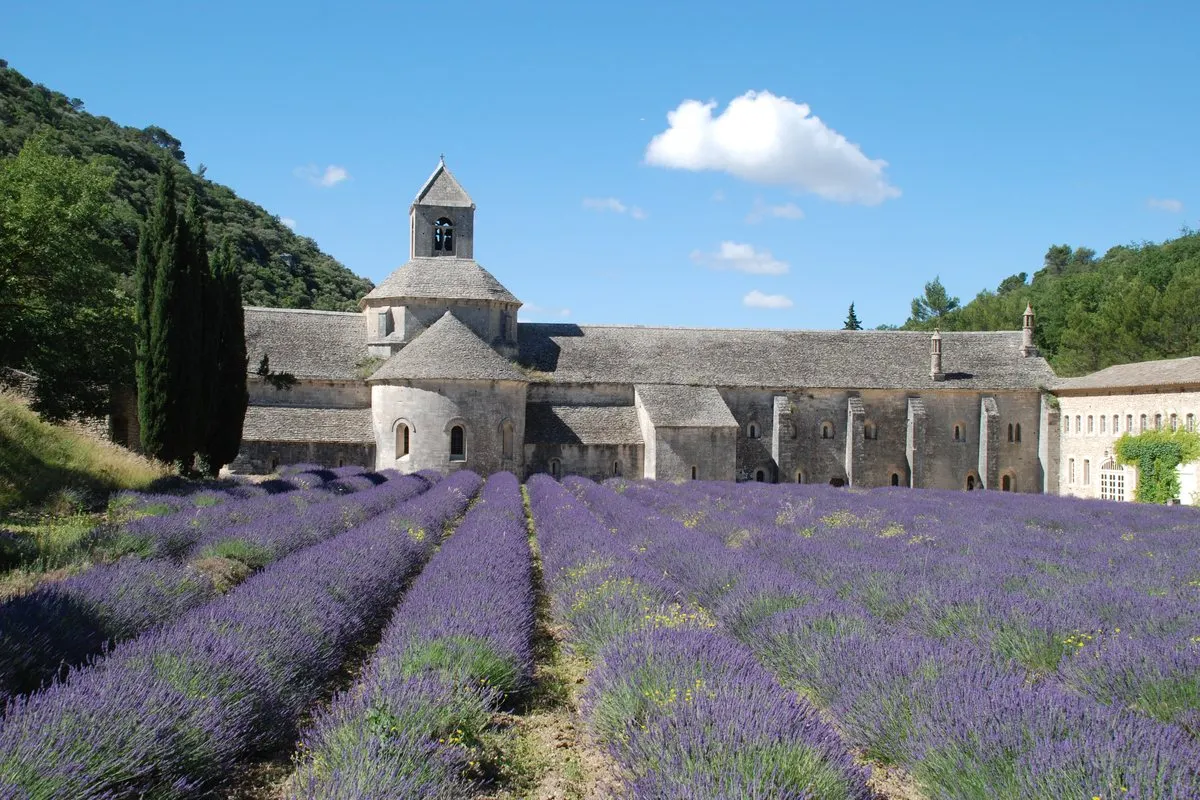
In the narrow valley of the Sénancole near Gordes, a small community of Cistercian monks still lives among buildings raised in the 12th century. The lavender in front of the abbey draws the cameras; inside, the bare stone is the real reason to come.
In this story · 3 sections
The Abbaye Notre-Dame de Sénanque is a working Cistercian monastery in the commune of Gordes, in the Vaucluse, set in the valley where the Sénancole stream runs. With Silvacane and Le Thoronet it is one of the “three Provençal sisters”, the trio of abbeys that bear witness to the reach of the Cistercian order in Provence. For the village above, see VERA PI's Gordes guide.
Abbaye Notre-Dame de Sénanque
Abbey · Gordes
A working monastery with a Romanesque church, cloister and dormitory.
01Founding and fortunes
Cistercian monks from Mazan in the Ardèche arrived on 23 June 1148, at the invitation of Alphant, Bishop of Cavaillon, and settled in temporary huts. By 1152 the community was large enough to found a daughter house. The Simiane family became its patrons, and the abbey church was consecrated in 1178. In the 13th and 14th centuries Sénanque ran four mills and seven granges; then came decline. In 1544 monks were hanged and the monastery burned by the Vaudois, and by the end of the 17th century only two religious remained.
Sold as national property in 1791, it was fortunately bought by someone who preserved it. Monks returned in the 19th century, were expelled in 1903, came back in 1926 and left again in 1969, when the five who remained could no longer maintain it. From 1970 the industrialist Paul Berliet leased and restored the abbey and ran a cultural centre there, with guests such as Pierre Mendès France, Edgar Morin and Jean Tinguely. In 1988 a small community came back from Lérins Abbey, near Cannes; there were six monks in 2022.
02Architecture of restraint
Sénanque is a remarkably untouched survival of Cistercian Romanesque. The church is laid out as a tau cross, and because the valley is so narrow its apse points north rather than east. Over the crossing rises a small square bell tower roofed in cut stone, typical of the order's sobriety. The cloister galleries are rhythmed by relieving arches over triplets of round arches, their capitals carved with the simplest water-leaf forms so as not to distract. Around it are the chapter house, the vaulted dormitory and the calefactory, the one heated room, where the monks could write. The church, cloister, chapter house and dormitory have been listed monuments since 1921.
Insider tipDress modestly; it is still a place of prayer.
03The lavender
The monks support themselves by growing lavender, in the field in front of the abbey, and by keeping bees. Individuals can also arrange a spiritual retreat. Remember that this is a working monastery: dress modestly and keep your voice down.
For more of the area, see VERA PI's Roussillon guide, its L'Isle-sur-la-Sorgue page and our destination guides.