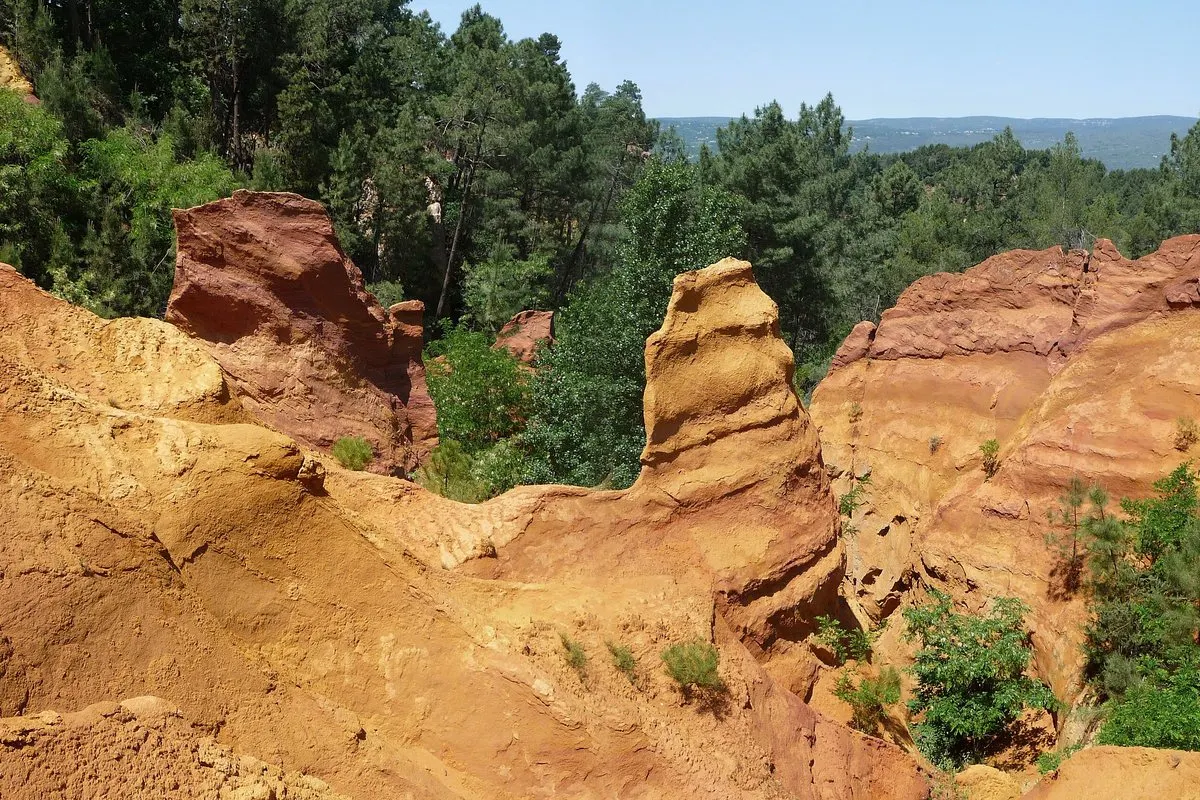
Roussillon stands on a ridge of ochre that once supplied pigment to the textile trade. The quarries closed in 1930; today a short trail winds through their orange and red cliffs, a former factory teaches the craft, and the village keeps the memory of Samuel Beckett's war years.
In this story · 5 sections
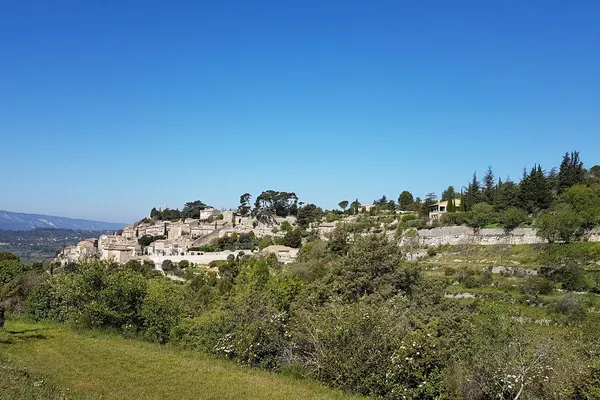
Roussillon lies in the Vaucluse, inside the Parc naturel régional du Luberon, on an ochre ridge in a broad valley between the Monts de Vaucluse to the north and the Petit Luberon to the south. It is one of Les Plus Beaux Villages de France, famous for the ochre deposits in the clay around it, in pigments ranging from yellow and orange to red. For the local property picture, see VERA PI's Roussillon guide.
2 places
© OpenStreetMap contributors · OpenFreeMap
An industry of colour
In the 18th century, rising demand for pigments from the textile industry intensified mining around the village. The big quarries of Roussillon were worked from the end of the 18th century until 1930, and thousands of people found work in quarries and factories in Roussillon, Villars, Gargas, Rustrel and Gignac. Modern techniques in the 20th century made other mines more profitable, the local workings closed one by one, and from the 1980s tourism replaced ochre as the village's living. Mining is now forbidden here to protect the sites.
The Sentier des Ocres
A former open-air quarry can be visited on the Sentier des Ocres, the Ochre Path. There are two routes, of 30 or 60 minutes, with explanatory panels along the way. Ochre stains easily, so leave pale clothes at the hotel.
Okhra: inside an ochre factory
The Usine Mathieu, named after the family that owned it from 1870 to 1901, has become the Conservatoire des Ocres, known as Okhra: a former ochre factory turned working museum, where workshops are held regularly.
Rustrel, Bruoux and Apt
The ochre country continues east. At Rustrel, the Colorado provençal is known for its orange hoodoos, with walks of 40 minutes or an hour and a half. The Bruoux mines have almost 40 kilometres of tunnels, of which a guided visit covers a few hundred metres; it is 10°C underground, so bring a jacket. In Apt, the Musée de l'aventure industrielle covers the town's three 20th-century industries: ochre, candied fruit and earthenware.
Beckett's village
Samuel Beckett hid from the Nazis in Roussillon from 1942 to 1945 and wrote his novel Watt there; the village is mentioned in Waiting for Godot. Laurence Wylie made it the subject of his book Village in the Vaucluse (1957), under the name Peyrane, and Henri Colpi filmed Fernandel here in Heureux qui comme Ulysse (1970). Around the village, cherries, peaches and melons are grown, and the vineyards fall within the Ventoux appellation.
For the rest of the Luberon, see VERA PI's Apt guide and its Gordes page, plus our destination guides.
Sentier des Ocres
A walk through an old quarry
Two marked routes of 30 or 60 minutes through the ochre cliffs.
Okhra, Conservatoire des Ocres
The former Usine Mathieu
A former ochre factory turned working museum, with regular workshops.