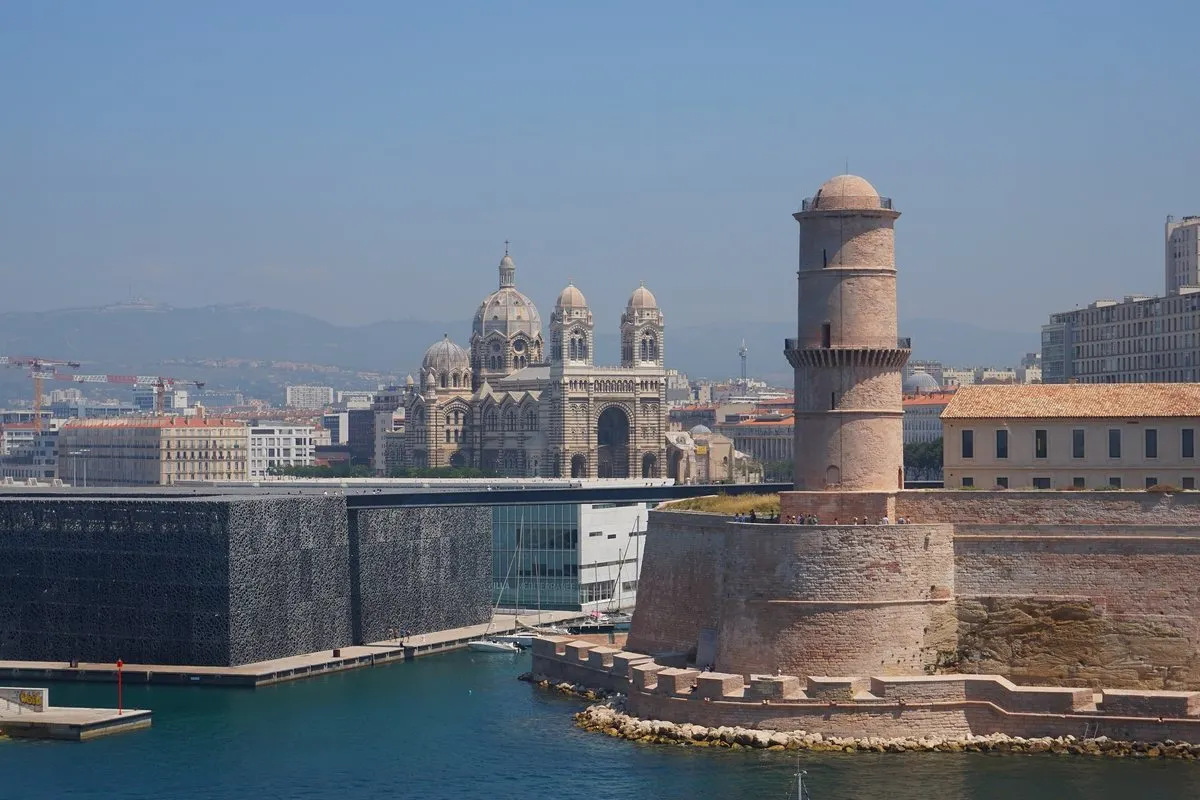
Rudy Ricciotti's cube wrapped in concrete lace opened in 2013, the year Marseille was European Capital of Culture. A 130-metre footbridge links it to a fort built by Louis XIV, and a second one runs on to the old streets of Le Panier.
In this story · 3 sections
The Mucem – the Musée des Civilisations de l'Europe et de la Méditerranée – stands on reclaimed land at the entrance to Marseille's harbour, in La Joliette, opposite the Fort Saint-Jean. It was built on the old J4 jetty, where ships once left for Algiers, as part of the Euroméditerranée regeneration, and inaugurated by François Hollande on 7 June 2013. It was the first French national museum devoted to the cultures of Europe and the Mediterranean. For the city's property picture, see VERA PI's guide to the 2nd arrondissement.
2 places
"Stone, water and wind"
Ricciotti, working with Roland Carta, described the J4 as a building “of stone, water and wind”. It is a square block 72 metres a side and 18 metres high, its facades wrapped in a lattice of ultra-high-performance fibre-reinforced concrete and the whole carried on 309 pillars of the same material. Two ramps climb around the outside of the building from the ground floor to the roof terrace, where there is a restaurant with views over the bay, the Corniche and the Prado. Yann Kersalé designed the lighting.
Inside, the Galerie de la Méditerranée on the ground floor shows semi-permanent displays, renewed every three to five years, across 1,600 square metres. Upstairs, two rooms of about 1,000 square metres each hold the temporary exhibitions. There is also a 400-seat auditorium. The collections, inherited from Paris's former Musée national des Arts et Traditions populaires and the Europe department of the Musée de l'Homme, now number around a million items, from furniture and costume to posters and sound archives.
Across the bridge: the Fort Saint-Jean
A footbridge 130 metres long crosses the dock to the Fort Saint-Jean, built by Louis XIV in 1660 at the entrance to the Old Port. It incorporated a 12th-century commandery of the Knights Hospitaller and the 15th-century tower of King René. Louis claimed the citizens were fond of fine fortresses; in truth the fort and its twin across the harbour, Fort Saint-Nicolas, were built after a local revolt, and their guns pointed at the town rather than the sea. Later the fort was a revolutionary prison and an army barracks, until it passed to the Ministry of Culture in 1962.
On its heights lies the Jardin des Migrations, 12,000 square metres planted with emblematic species from around the Mediterranean, with panoramic views of the city. A second footbridge leads on through the old Porte Royale to the Esplanade de la Tourette, by the church of Saint-Laurent in Le Panier.
Planning a visit
Allow time to walk the ramps, cross to the fort and see an exhibition. The museum drew 8.5 million visitors between 2013 and 2016 and 1.3 million in 2023, so expect company in high season. For more of the city, see VERA PI's Marseille guide, our destination guides and Metro Mode Travel.
Mucem (J4)
Rudy Ricciotti, 2013
The museum's main building, with ramps to a roof terrace and restaurant.
Fort Saint-Jean
Louis XIV, 1660
Reached by footbridge from the Mucem; home of the Jardin des Migrations.