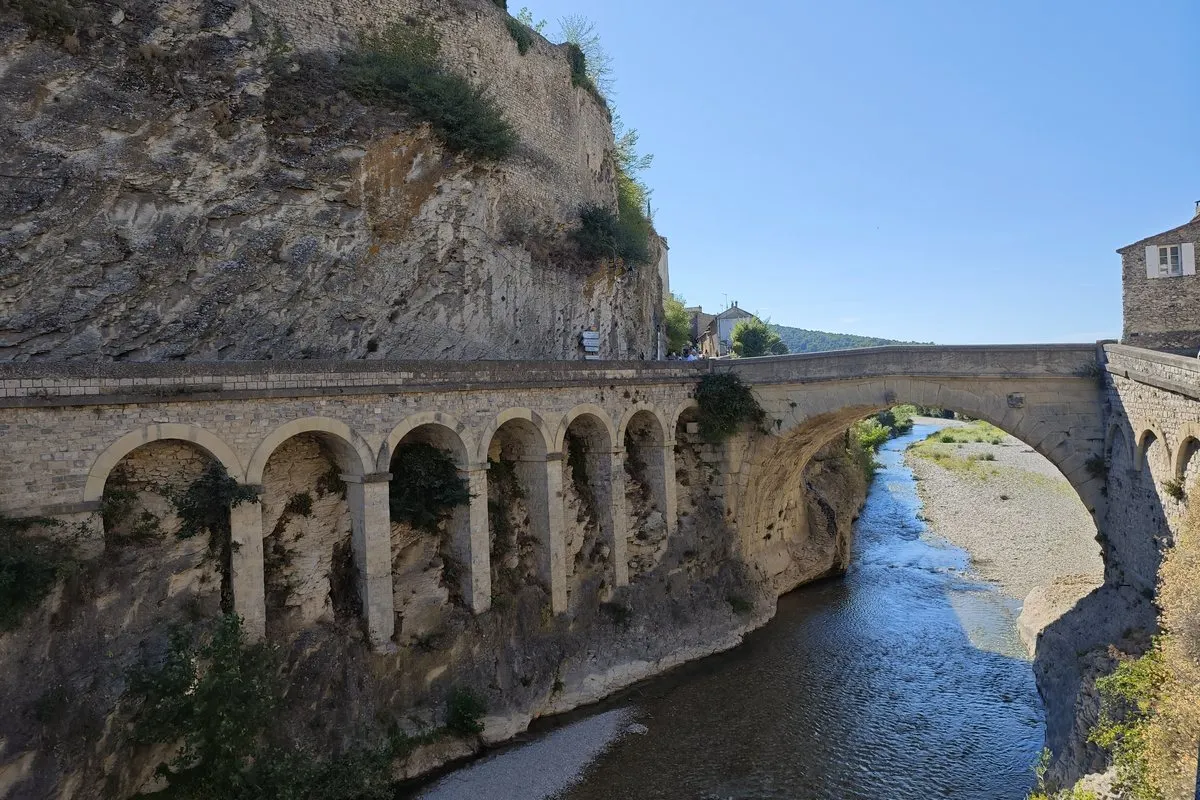
Beneath a modern Provençal town lie the streets of one of the richest cities of Roman Gaul. A single-arch bridge from the first century still carries traffic over the Ouvèze to a medieval upper town – and survived the flood that killed 37 people in 1992.
In this story · 4 sections
Vaison-la-Romaine lies in the north of the Vaucluse, about 27 kilometres from Orange and 50 from Avignon, with the Dentelles de Montmirail and the foot of Mont Ventoux each about 10 kilometres away. The river Ouvèze, known for its violent floods, divides the modern town – built over the Roman city – from the medieval Haute-Ville on its rock. For property here, see VERA PI's Vaison-la-Romaine guide.
2 places
Vasio, a rich Roman city
At the end of the 4th century BC Vaison became a capital of the Celtic Vocontii, whose oppidum stood where the Haute-Ville is now. After the Roman conquest it kept a degree of autonomy as a federated city, Vasio Vocontiorum, and from the second half of the 1st century AD it acquired a theatre, a bridge, aqueducts and baths. At its height in the 2nd century the city covered 70 to 75 hectares and was among the richest in Gallia Narbonensis; many houses with mosaic floors have been found. The theatre was built on a rocky hillslope, and a Roman statue found there in the 19th century, the Vaison Diadumenos, is now in the British Museum.
Fifteen hectares have been uncovered. La Villasse lies below the château of the same name and its avenue of two-hundred-year-old plane trees; further east, the hill of Puymin is marked by a large wooded area. The rest of the ancient city still lies under the modern town.
The Roman bridge
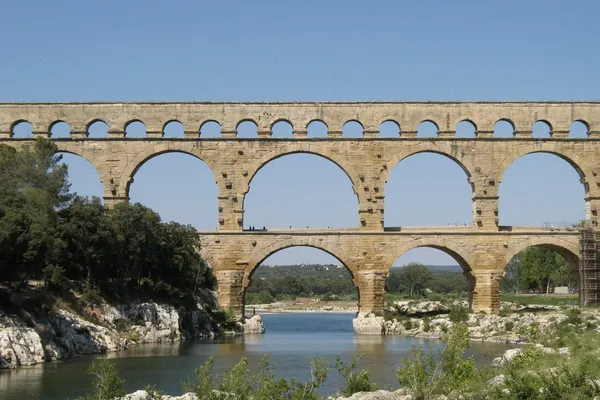
Built in the 1st century AD where the Ouvèze narrows to about 9.5 metres, the bridge is anchored in the rock of the Sus-Auze hill on one side and the castle rock on the other. It is a single arch with a span of 17.2 metres, made of five parallel round arches of eleven voussoirs each, joined only at the keystones, and stands 12.55 metres above the river. It was on France's first list of historic monuments in 1840. German demolition charges damaged it at the end of the Second World War, and in 1953 the vault was repaired. On 22 September 1992 it withstood the Ouvèze flood that devastated the region and killed 37 people; only its parapet was damaged.
Two cathedrals and a Haute-Ville
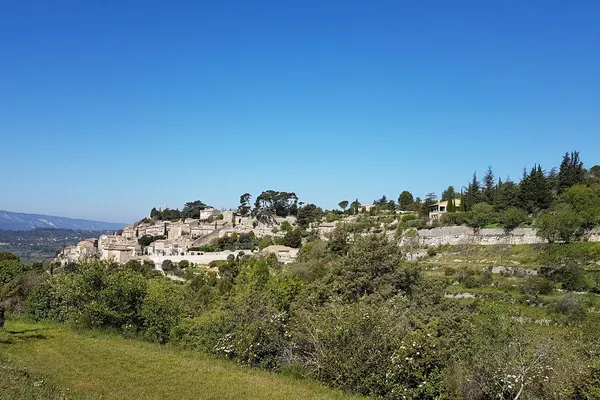
Vaison was a bishopric from the 4th century and hosted church councils in 442 and 529. West of La Villasse stand two Romanesque buildings, the chapel of Saint-Quenin and the cathedral of Notre-Dame-de-Nazareth with its cloister. In the 13th century the townspeople took refuge on the rock across the river, beneath a castle built by the Counts of Toulouse that later passed to the papacy; the medieval town that grew there survives as the Haute-Ville, with its own cathedral.
Market, festivals and the Dentelles
Vaison's Provençal market, authorised by Pope Sixtus IV in 1483, is one of the oldest and largest in Provence, with nearly 500 traders in summer. The town has four theatres, hosts the international Vaison Danses festival and is a “European Choral City”. Just to the south, the Dentelles de Montmirail – “lace”, for their jagged Jurassic limestone ridges – rise to 734 metres at Saint-Amand and offer more than 600 trails for walking, climbing and mountain biking, ringed by Rhône valley vineyards, with Gigondas, Vacqueyras and Beaumes-de-Venise among their communes.
For the wine villages, see VERA PI's Gigondas guide and its Séguret page; for more of Provence, our destination guides.
Pont romain
1st century AD
A single 17.2-metre arch over the Ouvèze, linking the modern town to the Haute-Ville.