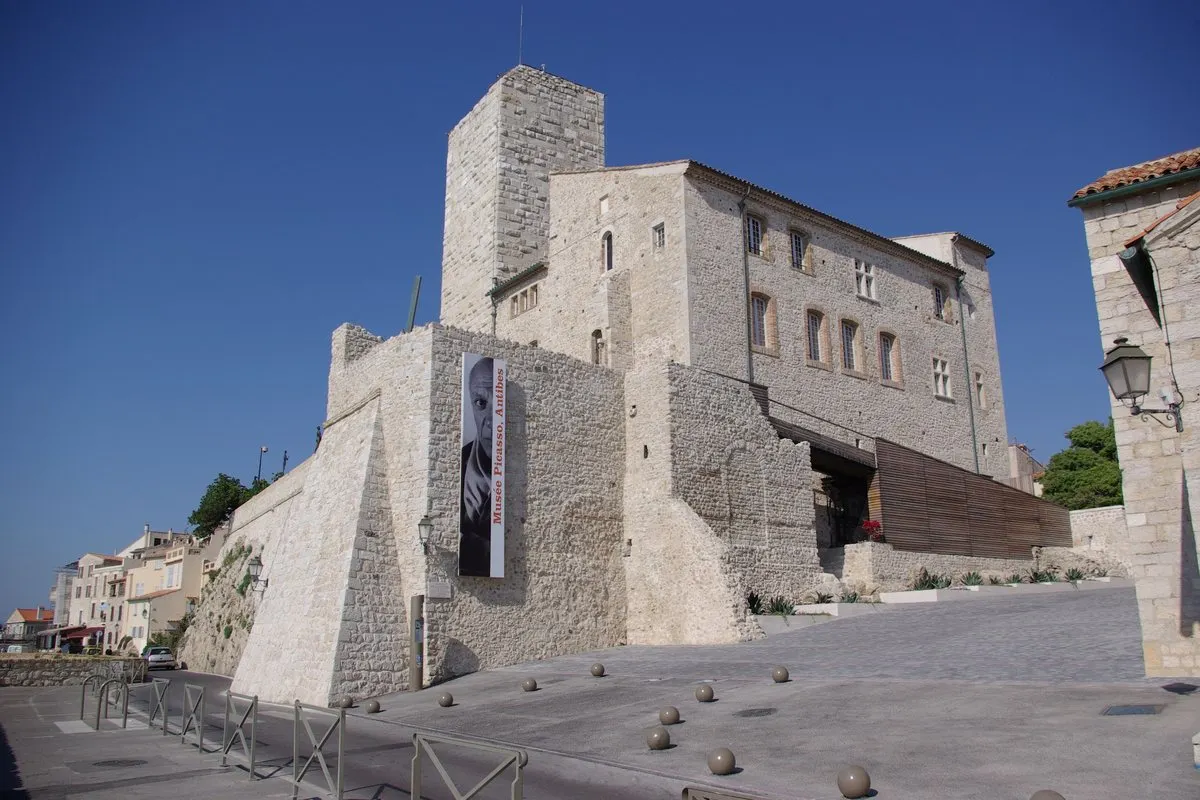
In the autumn of 1946, Pablo Picasso was given a studio in the Château Grimaldi on the city wall in Antibes. He stayed for two months and left behind 23 paintings and 44 drawings – and the castle became the world's first Picasso museum.
In this story · 5 sections
At the very edge of the town wall in the old town of Antibes stands a stone castle with a square tower, with the sea directly below. Château Grimaldi has been a bishop's residence, a barracks and a town hall. Today it is the Musée Picasso, and that is down to two autumn months in 1946 and a Latin teacher who asked the right person at the right moment.
Musée Picasso
Museum · Old town, Antibes
© OpenStreetMap contributors · OpenFreeMap
- Address
- Place Mariéjol, 06600 Antibes
- 16 September–14 June
- 10.00–13.00 and 14.00–18.00
- 15 June–15 September
- 10.00–18.00
- Closed
- Mondays, 1 January, 1 May, 1 November and 25 December
Château Grimaldi with Picasso's work from autumn 1946, Nicolas de Staël and the sculpture terrace.
01Château Grimaldi – from Antipolis to barracks
The castle stands on the acropolis of the Greek city of Antipolis, which later became a Roman castrum. According to the museum's press kit, Luc and Marc de Grimaldi received the estate as a fief on 27 May 1383, and in 1385 the family moved in and gave the castle its name. In 1608, Henry IV bought the castle and the harbour for the French crown. In 1792 it became the town hall, and from 1820 to 1924 it was a barracks.
In 1925 the town bought the abandoned castle for 80,000 francs and turned it into the Musée Grimaldi, an archaeological museum. The first curator was Romuald Dor de la Souchère, who taught French, Greek and Latin at the Lycée Carnot in Cannes and had begun excavating in Antibes in 1923. In 1928, the entire castle was classified as a historic monument.
02Autumn 1946 – Picasso's studio on the city wall
In August 1946, Picasso lived with Françoise Gilot in the villa Pour toi in Golfe-Juan. Dor de la Souchère offered him the opportunity to work in part of the castle, and from mid-September to mid-November he had his studio there. It was shortly after the war and materials were difficult to come by. He painted with the industrial paint Ripolin on fibre-cement sheets, plywood and other materials he came across.
Insider tipClosed on Mondays.
When he left the castle, 23 paintings and 44 drawings remained. Among them are La Joie de vivre, Satyre, faune et centaure au trident, Le Gobeur d'oursins, La Femme aux oursins, Nature morte à la chouette et aux trois oursins and La Chèvre, and the series of drawings Suite Antipolis. The work Les Clés d'Antibes he painted directly on the wall in the great hall, where it remains.
The Salle Picasso was inaugurated on 22 September 1947, and on 7 September 1948 Picasso gave the museum 78 ceramic works from the Madoura workshop in Vallauris. In 1957, he became an honorary citizen of Antibes. On 27 December 1966, the city council decided that the castle should be named Musée Picasso, the first museum dedicated to the artist. In 1990, the collection was supplemented by a donation from Jacqueline Picasso.
03Nicolas de Staël, Hartung and Bergman
The museum is more than Picasso. Nicolas de Staël lived in Antibes from September 1954 to March 1955, and his widow made a first donation following an exhibition in 1955. Since 1982, the town has purchased further works. In 2001, the Hans Hartung and Anna-Eva Bergman Foundation made a donation that opened up two further vaulted rooms. The modern collection also includes works by, among others, Calder, Modigliani, Ernst, Klein, Soulages and Viallat.
04The terrace and the sculptures facing the sea
On the castle terrace facing the sea stands a permanent collection of sculptures by Germaine Richier, along with works by Joan Miró, Bernard Pagès and Anne and Patrick Poirier. During the renovation, a project presented in 2008 with the architect Pierre-Antoine Gatier, the museum was divided so that the Picasso collection and the 1946 studio are displayed on the second floor, de Staël and temporary exhibitions on the first floor, and Hartung and Bergman on the ground floor.
Source: Antibes Juan-les-Pins Tourist Office. The ticket desk closes at 12.30 and 17.00. Prices are available from the museum.
05Old Antibes around the museum
The museum is located in the heart of the old town, a few minutes from the market hall on Cours Masséna. Read our walk through Old Antibes, from the Greek Antipolis to Picasso's castle and our guide to the coastal path at Cap d'Antibes, and see more Riviera guides on metromode.co.