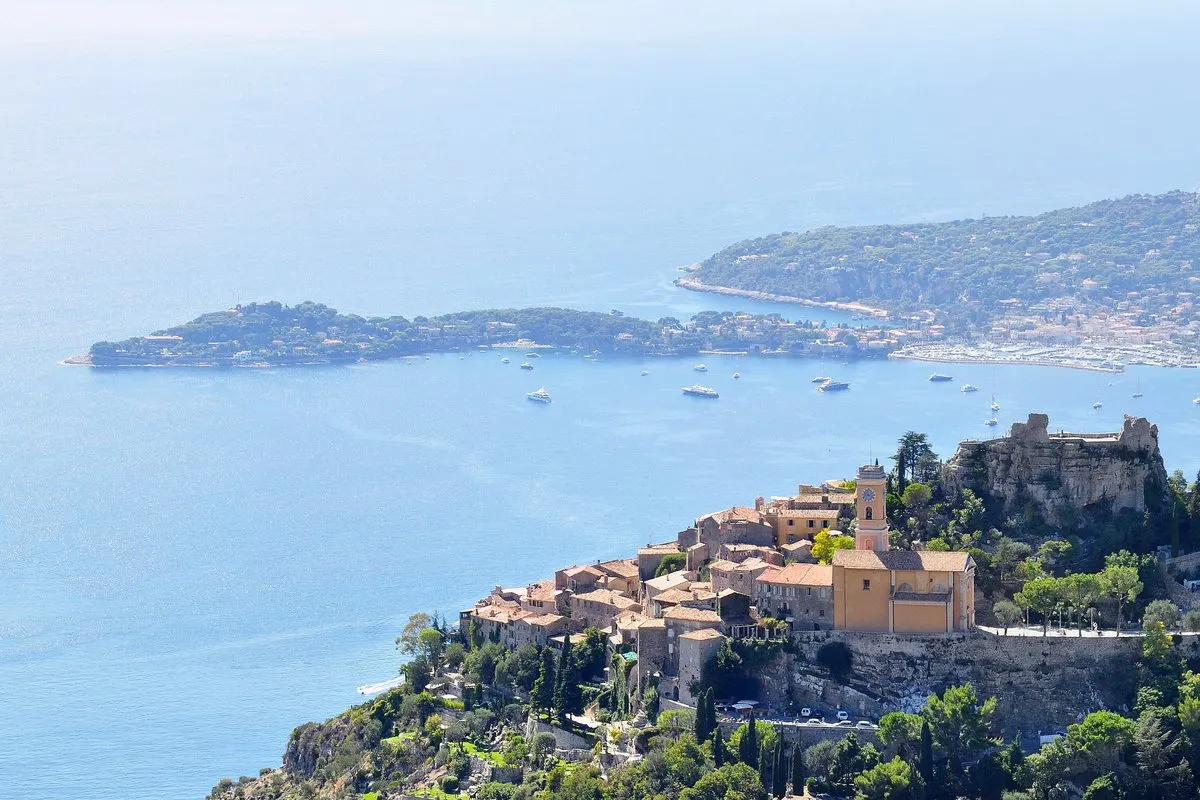
Three roads, three altitudes, the same journey. The Basse, Moyenne and Grande Corniche wind their way between Nice and Menton and meet in Roquebrune-Cap-Martin. Our guide to the Riviera's classic drive – stretch by stretch.
In this story · 7 sections
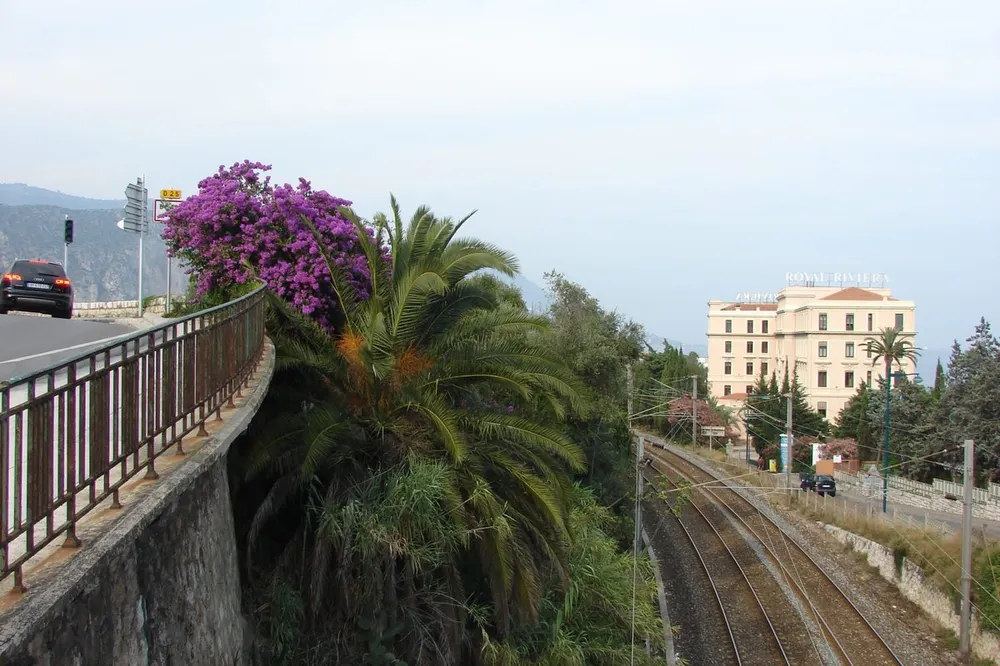
Between Nice and Menton, the mountains rise almost vertically out of the sea. If you want to head east, there are three roads to choose from, stacked on top of each other along the slope: the Basse Corniche by the water, the Moyenne Corniche a little further up, and the Grande Corniche right at the top along the cliffs. The word corniche comes from the French route à corniche, meaning road on a ledge, which in turn comes from the Italian cornice. Here is our guide to the Riviera's classic drive.
4 places
Three roads, same journey
All three start at Port Lympia, the harbour of Nice, and end at the border with Italy in Menton. Along the way, they pass through Villefranche-sur-Mer, Beaulieu-sur-Mer, Èze, Cap-d'Ail, La Turbie, Beausoleil and Roquebrune-Cap-Martin, where they merge. The Basse Corniche also passes through Monaco. Since the A8 motorway opened between Roquebrune and the Italian border in 1969, no one needs to take the Corniche roads to cross the department – you drive them for the view.
At a glance
The three roads
| Road | Number today | Passes |
|---|---|---|
| Basse Corniche | D6098 (formerly N98) | Along the sea, through Monaco |
| Moyenne Corniche | M6007 (formerly N564) | Col de Villefranche, Èze |
| Grande Corniche | D2564 | Col des Quatre-Chemins, Col d'Èze, La Turbie |
Basse Corniche – the road by the water
The Basse Corniche was formerly route nationale 98 and has since 2005 been called the D6098, also known as the Route du bord de mer. It follows the coast from Nice, through Villefranche-sur-Mer and Beaulieu-sur-Mer, onwards through Cap-d'Ail and Monaco, and reaches Menton after the other two have joined it in Roquebrune. It is the slowest road but also the one that runs closest to the villages and beaches. In Cap-d'Ail, the last town before the border with Monaco, the beach Plage Mala is a popular destination.
Moyenne Corniche – through Èze
The Moyenne Corniche, formerly national road 564 and today the M6007, leaves Nice, crosses the Col de Villefranche and continues to Roquebrune-Cap-Martin, where it connects to the Basse Corniche. It passes right next to the hilltop village of Èze, and parts of the area around Èze have been a protected landscape since 1912.
Grande Corniche – Hitchcock's view
The Grande Corniche, today the D2564, is the highest road. It leaves Nice, crosses the Col des Quatre-Chemins and the Col d'Èze, and reaches Roquebrune-Cap-Martin via La Turbie, where it connects with the Moyenne Corniche. This is where the classic picture is taken: Èze on its cliff and Cap-Ferrat further out in the sea. The road appears in Alfred Hitchcock's To Catch a Thief.
The landscape below the road is protected in stages. The land below the Grande Corniche in Villefranche-sur-Mer was classified in 1937, the land below the road in Èze the same year, and in Roquebrune-Cap-Martin in 1971. Since 1973, all three roads have formed part of the protected area Littoral de Nice à Menton.
Roquebrune – where the roads meet
In Roquebrune-Cap-Martin, the roads merge together. The medieval village was founded in 971 by Conrad I, Count of Ventimiglia, and the castle, Château de Roquebrune, was built at the end of the 10th century to keep the Saracens away. From 1355, the town belonged to the Grimaldi family for five centuries. The castle was inhabited until 1800 and has been protected as a historic monument since 1927. From the top platform, you can see the village's rooftops, the sea, Cap Martin, Monaco and Mont Agel.
In 1804, Napoleon had a road built along the coast linking the village with the rest of the Côte d'Azur. Towards the end of the 19th century, the railway arrived, bringing with it the winter guests. Empress Elisabeth of Austria spent several months in the years 1894–1897 at the Hôtel du Cap Martin.
Cap Martin – Eileen Gray and Le Corbusier
On Cap Martin stands E-1027, the modernist villa designed and built by Eileen Gray and Jean Badovici in 1926–1929. Le Corbusier painted murals in the house in 1938–1939, something Gray regarded as vandalism, and later built his own little cabin, the Cabanon, right next door. He drowned in the sea below it on 27 August 1965 and is buried in the local cemetery. After a lengthy restoration, E-1027 opened to the public in July 2021, and visits are only possible with a guide, in groups of no more than twelve people.
How to do the drive
One way is to drive out along the Grande Corniche for the views and back along the Basse Corniche for the villages and the sea, stopping in Èze on the Moyenne Corniche. At the end of the road, spend the afternoon in Menton. More addresses along the way can be found in our guide to Monaco and among our Riviera guides on metromode.co.
Port Lympia
Start for all three roads
The port in Nice where the three Corniche roads begin.
Château de Roquebrune
Where the roads meet
Castle from the late 10th century with views over Cap Martin and Monaco.
E-1027
Eileen Gray's villa on Cap Martin
Modernist villa from 1926–1929, open for guided tours since 2021.
Insider tipGuided visits only.